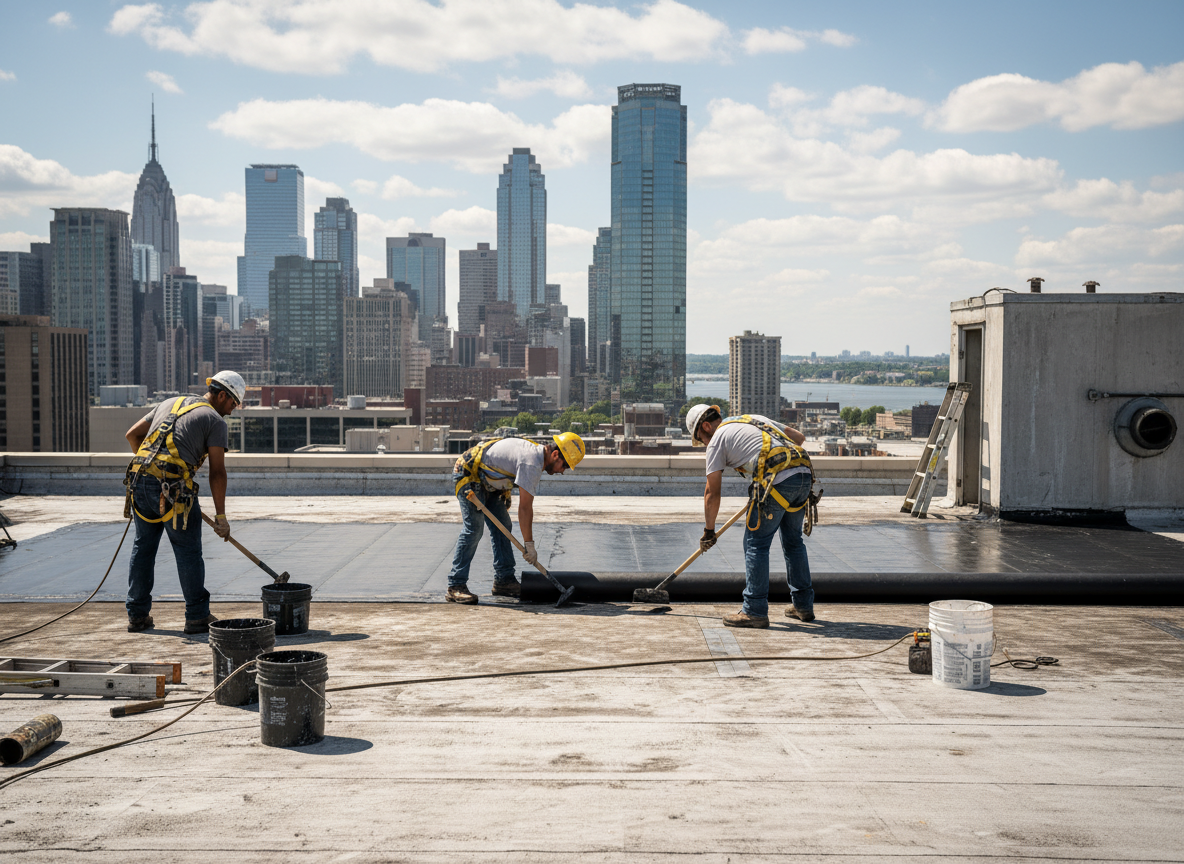
Gloucester City's mix of aging industrial buildings and small commercial storefronts near the Delaware River waterfront means flat and low-slope roofs take a beating from river humidity, seasonal ice, and salt-laden air drifting off the water. Properties along Broadway Historic District and near the port often have older membrane systems patched over decades, which leads to seam separation and ponding water issues that surface fast once summer humidity gives way to freeze-thaw cycles in winter. Buildings near I-676 and NJ-42 truck routes also see more vibration-related fastener loosening than typical suburban commercial roofs. Repair crews working here need to account for river-adjacent moisture infiltration and older roof decking common to this Camden County port town.
Commercial Roof Repair in Gloucester City — What We Handle
- ✓Waterfront humidity and river proximity accelerate membrane wear and seam failure
- ✓Older industrial and warehouse stock near Broadway Historic District often has legacy roofing systems needing careful patch-matching
- ✓Truck traffic along US-130 and NJ-42 corridors adds vibration stress not seen on quieter side streets
Commercial Roof Repair Services We Offer in Gloucester City
✓Flat Roof Leak Repair
Leak tracing on TPO, EPDM, PVC and built-up roofs to locate the actual entry point rather than the visible stain, followed by a repair matched to the system.
✓TPO, PVC and EPDM Membrane Repair
Hot air welded seam repair, patching, and re-adhering membrane that has pulled away at parapets and curbs, using the manufacturer's method where a warranty is still in force.
✓Flashing and Penetration Repair
Re-flashing HVAC curbs, vent stacks, conduit stands and abandoned penetrations that were never sealed properly, which is one of the most common hidden leak sources.
✓Ponding Water and Drainage Repair
Correcting slope, clearing blocked drains and scuppers, and adding drainage capacity where water sits on the roof for days after a storm.
✓Wet Insulation Removal
Cutting out and replacing saturated polyiso and cover board so the new patch sits on a dry, sound substrate instead of trapping water underneath.
✓Metal Roof Repair
Fastener replacement, seam resealing and rust through panel repair on warehouse and industrial metal roofs, where caulk alone will not hold.
✓Storm and Emergency Repair
Temporary tarping and sealing to stop water entering the building after wind or storm damage, with photographs and notes recorded for insurance, then a permanent repair once conditions allow.
✓Roof Coating and Preventive Patching
Reflective coatings and preventive patching for membranes that still have life left but need protection to reach the end of their service life.
A leak on a commercial building rarely stays a roof problem for long. It becomes a tenant complaint, damaged inventory, or a rooftop unit sitting in standing water. Most New Jersey commercial buildings carry low-slope roofs, and the system on top tells you a lot about how it will fail. TPO and PVC hold up well across the open field but split at hot air welded seams, particularly along traffic paths near rooftop HVAC equipment where the membrane has been walked on for years. EPDM shrinks as it ages and pulls away from parapets and curbs. Built-up roofs blister, alligator and lose their surfacing. Modified bitumen splits at the laps. Identifying the failure mode before anyone cuts into the roof is what stops a crew from opening a section that was never the source.
The stain inside is a poor guide to where the water gets in. It travels along insulation joints, deck flutes and curb bases, and the entry point can sit tens of feet from the drip. That is why a repair call starts with a walk of the entire roof rather than the corner above the stain. Seams, laps, terminations, pipe boots and every curb get checked. When the source stays hidden, seam probing, a flood test on an isolated section, or an infrared scan after sunset will find it, since wet insulation holds heat differently from dry insulation and shows up clearly once the surface cools.
How It Works in Gloucester City
- 1
Roof walk and leak trace
The walk covers the whole roof, not the area under the stain. Drains, scuppers, seams, laps, terminations, pipe boots and every curb get checked, and where the source is not obvious we probe seams, flood test a section, or run an infrared scan to locate wet insulation. This is what stops a crew from cutting into a section that was never the problem.
- 2
Insulation and deck check
Core samples or an infrared scan show whether the polyiso under the membrane is dry. That answer decides whether a patch will hold or whether the wet section has to come out first. It also tells you honestly whether the roof is still worth repairing at all.
- 3
Written itemized quote
You get an itemized quote before anything starts, showing the scope, the materials and what is driving the cost. No change orders appear once the crew is on the roof unless something is found that was not visible during the walk, and that gets discussed with you before the work continues.
- 4
Repair and membrane work
Hot air welding, patching, re-flashing, curb detailing or panel work, done with materials matched to the existing system. Where the roof is still under a manufacturer warranty, the repair follows that manufacturer's method and materials so the coverage stays intact.
- 5
Water test and drainage check
The repaired area and the surrounding drainage get tested to confirm water moves off the roof rather than sitting on the patch. Sealing one spot while the water still ponds around it is how the same repair comes back a season later.
- 6
Documentation handoff
You get photographs and written notes covering what was repaired, what was found and what to keep an eye on. That record is useful for an insurance claim, for a warranty file, or simply for knowing the roof's history when the next issue comes up.
Serving All of Gloucester City
We regularly handle commercial roof repair jobs near:
- 📍Gloucester City Waterfront Park
- 📍Broadway Historic District
- 📍Delaware River
- 📍Gloucester Heights
Commercial Roof Repair Pricing in Gloucester City
Commercial roof repair costs are driven by a short list of things: how much roof has to come up, the membrane type and thickness, whether the insulation underneath is dry or has to be cut out and replaced, roof access and staging on the site, and whether drainage work is part of the fix. A small localized patch on an accessible roof sits at the low end. Repairs involving several failure points, wet insulation removal, or slope correction cost considerably more. Every quote is written and itemized before work starts, so you can see which of those factors is driving the number.
Want the full picture of this service? See our Commercial Roof Repair page, or everything we do in Gloucester City, NJ.