
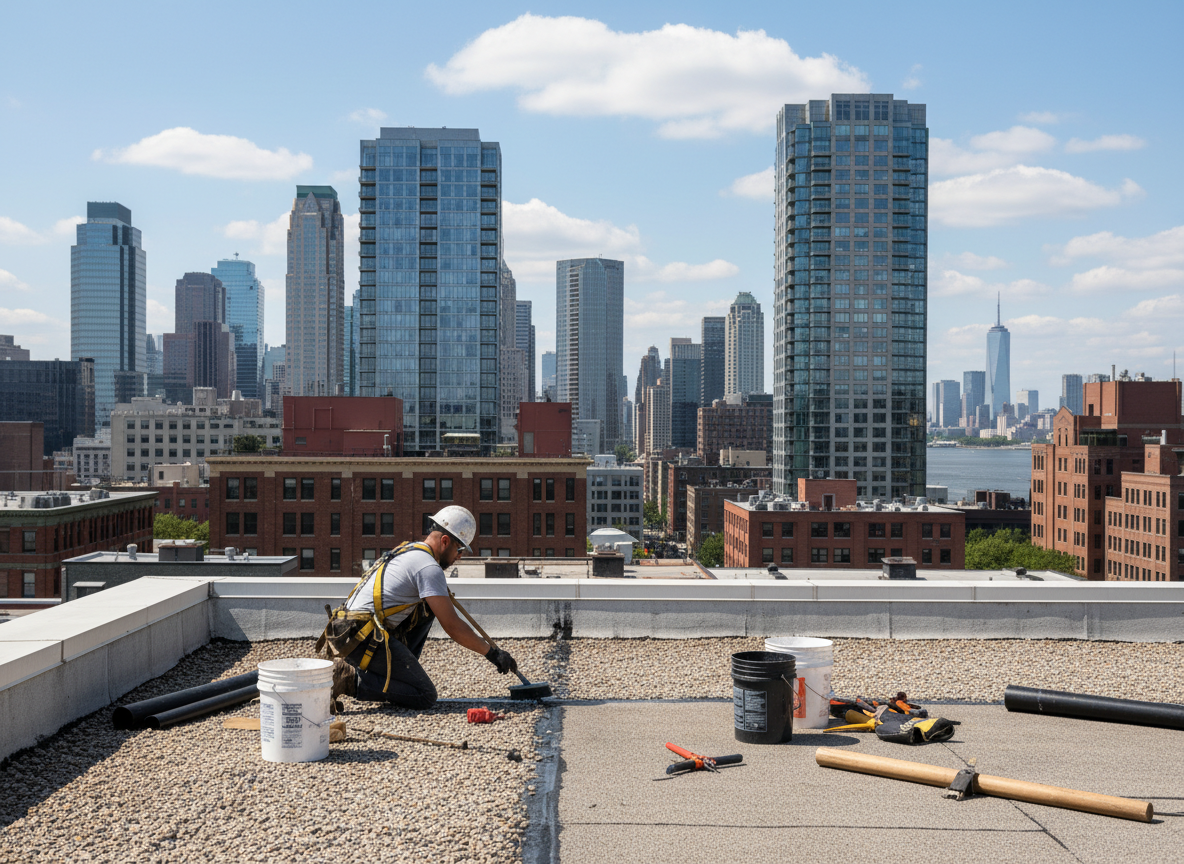
Commercial roofs rarely fail because of one storm. They fail because nobody walked the roof after the winter, or cleared the drains before the summer downpours. A scupper filling with granules and leaves backs water up until it finds a seam that has been sitting under UV for a decade, and the first anyone knows about it is a stain spreading across a tenant's ceiling. The cost of a maintenance visit sits a long way below the cost of tracing that leak through three tenant spaces and then replacing the insulation underneath it.
The work is shaped by what this climate does across a year. Summer heat softens asphalt and bitumen systems and drives UV breakdown at exposed seams. Winter freeze and thaw opens cracked flashing and dried pitch pans. A spring visit deals with what the winter opened and clears the debris the wind put there. An autumn visit clears leaf fall from the drains and closes up anything that would otherwise turn into an active leak by February. Between them, the roof gets checked twice a year at the times when checking it is worth the most.
Commercial Roof Maintenance Near You — Choose Your City
Every city below has its own local Commercial Roof Maintenance page with coverage details.
Middlesex
Union
Essex
Hudson
Camden
Bergen
Cumberland
Other areas
Hudson County
Passaic
Atlantic
Mercer County
Somerset
Passaic County
Atlantic County
Gloucester
Cape May County
Monmouth
Monmouth County
Bergen County
Essex County
Mercer
A maintenance visit is not just a walk and a report. Drains, scuppers and gutters get cleared. Sealant at terminations, pitch pans and pipe boots gets renewed before it dries out and cracks. Lifted seam edges get resealed while the failure is still an edge rather than an opening. Debris that would otherwise block drainage or abrade the membrane gets removed. Small things done on the visit are the point of the exercise, because the alternative is the same problems being written up in a report and left until they are no longer small.
Rooftop equipment areas take a disproportionate share of the damage, and most of it comes from people rather than weather. Every mechanical contractor, telecoms installer and solar technician who goes up there is another chance for a membrane to be nicked, a fastener driven through, or sealant disturbed around a curb. That damage almost never gets reported, so it emerges as a leak months later with no record of what caused it. Knowing who has been on the roof, and checking the areas around recent equipment work, is part of what a programme actually buys. Walk pads along the routes technicians use are one of the cheapest interventions available and are routinely skipped.
Documentation is the part that pays off years later. Most commercial roof warranties, and no dollar limit coverage in particular, require documented periodic maintenance for the coverage to remain valid, and claims do get refused on the grounds that the record was never kept. A maintenance log with dated visits, photographs and a note of what was done each time is what makes a claim defensible. It also gives you a picture of how the roof is ageing, which is what a realistic replacement budget is built on.
Commercial Roof Maintenance Services We Offer
✓Scheduled Maintenance Programmes
Twice yearly visits in spring and autumn at a fixed annual cost, timed around the freeze and thaw cycle so the roof gets attention when it is worth the most.
✓Drain, Scupper and Gutter Clearing
Clearing debris, granules and leaf fall from internal drains, scuppers and gutters, which is the single most effective thing that can be done to extend the life of a low-slope roof.
✓Seam and Lap Resealing
Checking TPO, PVC, EPDM, modified bitumen and built-up seams and laps, and resealing lifted edges while the failure is still an edge rather than an opening.
✓Pitch Pan and Penetration Sealing
Renewing sealant at pitch pans, pipe boots, terminations and equipment curbs before it dries and cracks. These fail years ahead of the field membrane and account for a large share of leaks.
✓Ponding Water Monitoring
Recording where water sits past 48 hours after rain and identifying whether the cause is debris, an undersized drain or a slope problem, so it is dealt with before the membrane suffers for it.
✓Walk Pad Installation and Traffic Protection
Laying walk pads along the routes service technicians actually use, so the membrane is not compressed and abraded where rooftop equipment gets serviced year after year.
✓Rooftop Equipment Area Checks
Checking the areas around recent equipment work by mechanical, telecoms and solar contractors, since damage caused by other trades is rarely reported and shows up later as an untraceable leak.
✓Preventive Coating Touch-ups
Reflective and protective coating repairs on worn areas to extend membrane life between full recoats, applied where the membrane still has enough life left to justify it.
✓Maintenance Log and Warranty Documentation
A dated log with photographs and a record of what was done on every visit, formatted to meet the documented maintenance requirement most manufacturer warranties carry.
How it works
- 1
Programme set up and scheduling
Visits are set up for spring and autumn at the outset, with access coordinated through facilities staff or the property manager around building hours and tenant activity. On warehouse and distribution buildings the timing works around loading dock and shipping schedules.
- 2
Full roof walk
Every drain, scupper, seam, lap, termination, pitch pan, pipe boot and equipment curb gets checked and photographed. Areas around any recent rooftop equipment work get particular attention, since damage caused by other trades is rarely reported.
- 3
Drainage clearing
Drains, scuppers and gutters are cleared of debris, granules and leaf fall so water has somewhere to go before the next storm. Blocked drainage is the most common cause of the ponding that shortens a roof's life.
- 4
Preventive work on the day
Sealant at terminations, pitch pans and penetrations gets renewed before it dries and cracks. Lifted seam edges are resealed, small punctures patched, and loose flashing refastened, all while the failures are still minor enough to fix on the visit.
- 5
Report and maintenance log
You receive a dated report with photographs covering what was found, what was put right on the visit, and what needs scheduling separately. It is written to serve as the maintenance record your warranty requires and as the basis for your roof budget.
- 6
Separate quotes and next visit
Anything beyond the scope of a maintenance visit, such as a drainage correction, wet insulation removal or a larger flashing rebuild, is quoted separately with no obligation. The next visit is set before we leave.
Pricing
Maintenance is priced by roof area, the number of roof levels, how difficult access is, and how much rooftop equipment there is to work around. Most buildings are set up on a twice yearly programme at a fixed annual figure so it can go straight into an operating budget rather than being approved visit by visit. Minor work carried out during a visit is included. Anything larger, such as a drainage correction or a section of wet insulation, is quoted separately before it goes ahead.