
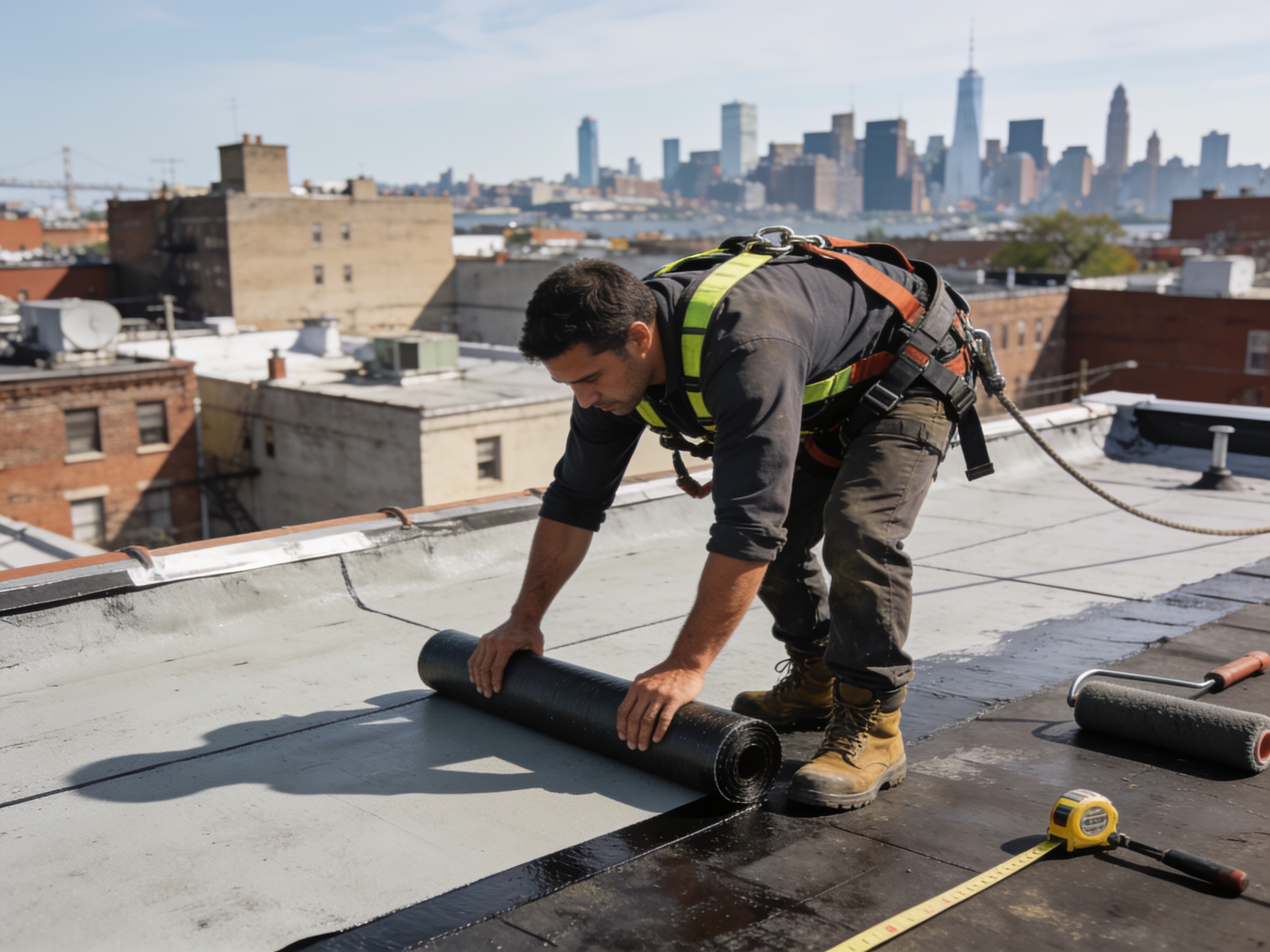
Almost every commercial building in New Jersey has a flat or low-slope roof, and they fail in ways that pitched roofs do not. There is no gravity helping water shed, so every seam, penetration, termination and drain has to do its job. A pitched roof sheds water through geometry. A low-slope roof holds it and then moves it, which means the assembly rather than the slope is what keeps the building dry.
The term flat is misleading. These roofs are built with a slight pitch toward the drains, commonly a quarter inch per foot, and the difference between a roof that drains and one that ponds is often a fraction of an inch across a long run. This page covers what is actually up there on New Jersey commercial buildings, how each system behaves, and what decides which one belongs on a given roof.
The systems in service
Five system types account for the overwhelming majority of low-slope roofs in this state, and they arrived in roughly that order historically, so the age of a building is a reasonable predictor of what is on it.
Built-up roofing is the oldest of them and still in service across older industrial stock. Multiple plies of felt in bitumen, usually with a gravel surface. It is heavy, durable, and it fails by alligatoring, blistering and losing its surfacing. Repairs need materials matched to the existing plies.
Modified bitumen followed, applying similar chemistry in rolled sheets with polymer modification for flexibility. It is applied torch down or cold adhesive, comes in SBS and APP variants, and splits at the laps as it ages.
EPDM is a thermoset rubber sheet, standard on a great deal of what was re-roofed through the 1990s and 2000s. It handles UV and temperature cycling well and resists punctures better than the thermoplastics. Its seams are adhesive or tape bonded rather than welded, which makes the seam the weakest part of the assembly, and it shrinks with age, pulling away from parapets and curbs.
TPO is a thermoplastic with heat welded seams, white and reflective, and it now holds the largest share of the low-slope market. It performs well across the open field and fails at the welds, particularly along traffic routes near rooftop equipment.
PVC is also a hot air welded thermoplastic and shares the reflectivity, with one property that decides its use: resistance to oils, greases and chemicals. On buildings with rooftop grease exhaust or process discharge it is the correct specification rather than a preference.
What sits underneath
The membrane is the visible layer and the least of it. Beneath sits the deck, which carries the load and may be steel, concrete or wood. Above that, where the building requires one, a vapour retarder controls moisture driven up from inside. Then insulation, which provides the thermal value and, if it is tapered, the slope. Then often a cover board, giving the membrane a sound substrate and adding impact resistance.
That assembly is where most of the money and most of the performance sit. New Jersey is in climate zone 4A, and the energy subcode sets a minimum continuous insulation value that older buildings frequently do not meet, so a replacement is the point at which it has to be corrected. On a large conditioned building the insulation affects operating cost more than the membrane colour does.
It is also where the worst failures hide. Wet insulation does not dry out on its own. It destroys the thermal value, corrodes the deck, and spreads laterally under a membrane that still looks acceptable from above. Core samples or an infrared scan are what find it, and the answer decides whether a roof is repairable at all.
How low-slope roofs actually fail
Rarely in the field. The failures concentrate where the membrane has to do something other than lie flat: seams and laps, flashing at parapets and curbs, terminations, pipe boots, drains and any penetration added after the original installation.
Drainage is behind a large share of it. Water standing more than 48 hours after rain is the standard threshold at which it stops being drainage lag and becomes a defect. It loads the deck, accelerates membrane breakdown, and works into any seam already starting to open. On roofs where it has run for years, the deck deflects, the low spot deepens, and the problem compounds.
Rooftop equipment causes more damage than most owners expect, and most of it comes from people rather than weather. Mechanical, telecoms and solar contractors working on rooftop plant can nick a membrane or disturb sealant at a curb, and it is almost never reported.
What decides the specification
Owners usually think they are choosing a membrane. In practice the decisions that determine how long the roof lasts sit below that.
Thickness matters: 60 mil is the commercial standard for single ply, and thinner sheets are cheaper and shorter lived. Attachment method matters: mechanically attached, fully adhered and ballasted assemblies behave differently under wind and cost differently. Wind uplift rating matters: the assembly needs a documented FM or UL classification matched to the design wind speed for the site, with fastening tightened at perimeters and corners. And insulation matters, both for code compliance and for what the building costs to run.
A proposal naming only the membrane brand has left out most of what determines performance.
Where to go from here
If you do not know what is on your roof or how many layers it carries, a commercial roof inspection establishes both, along with whether the insulation underneath is still dry. For system by system detail, see TPO commercial roofing, EPDM commercial roofing and metal commercial roofing.
For work on an existing roof, commercial roof repair covers seam, flashing and penetration failures, commercial roof leak repair covers detection and active water intrusion, and commercial roof maintenance is what gets any of these systems to the end of its service life. Where a roof has reached that end, commercial roof replacement covers the tear off versus recover decision.
Related reading: TPO vs EPDM vs PVC for New Jersey warehouse roofs and why ponding water is the leading cause of flat roof failure.
Flat Commercial Roofing Services We Offer
✓TPO Single Ply
Heat welded thermoplastic single ply, white and reflective, now the largest share of the low-slope market. Available in 45, 60 and 80 mil, with 60 mil the commercial standard. Strong across the field, fails at the welds.
✓PVC Single Ply
Hot air welded thermoplastic with the same reflectivity plus resistance to oils, greases and chemicals. The correct specification for restaurants and any building with rooftop grease or process exhaust.
✓EPDM Rubber Membrane
Thermoset rubber sheet with adhesive or tape bonded seams. Handles UV and temperature cycling well and resists punctures, but the seam is the weakest part of the assembly and the sheet shrinks with age.
✓Modified Bitumen
Polymer modified asphalt in rolled sheets, applied torch down or cold adhesive, in SBS and APP variants. Suited to roofs with heavy foot traffic and dense equipment pads. Splits at the laps as it ages.
✓Built-up Roofing (BUR)
Multiple plies of felt in bitumen, usually gravel surfaced. Still in service across older industrial stock. Heavy and durable, failing by alligatoring, blistering and loss of surfacing.
✓Insulation and Cover Board
Polyiso insulation, cover board and where required a vapour retarder, specified to meet the continuous insulation value the energy subcode sets for climate zone 4A. This layer affects operating cost more than the membrane does.
✓Tapered Insulation Systems
Polyiso manufactured at a slope, laid to a designed layout to build pitch into the assembly without touching the structural deck. Corrects drainage and adds insulation value at the same time.
✓Attachment and Wind Uplift
Mechanically attached, fully adhered and ballasted assemblies behave differently under wind and cost differently. The assembly should carry a documented FM or UL uplift classification matched to the design wind speed for the site.
How it works
- 1
Identify what is actually up there
Core samples or an infrared scan establish which system is on the roof, how many layers it carries, what insulation is beneath and whether that insulation is dry. Everything after this depends on those answers, and none of them can be reached by walking the roof and looking.
- 2
Assess the condition of the details
Membrane condition across the field, seams and laps, flashing at parapets and curbs, terminations, penetrations, drains and scuppers, and the condition of any previous patch work. Findings get ranked so what needs money now is separated from what needs watching.
- 3
Establish how the roof drains
Drains and scuppers checked for flow, low areas that hold water past 48 hours mapped, and the cause identified: blockage, undersized or badly placed drainage, insufficient slope, or deck deflection. Each of those has a different fix and a very different cost.
- 4
Determine repair, recover or replace
The condition of the assembly and the layer count decide the options. Isolated failures over dry insulation are a repair. Dry insulation with a widely failed membrane and only one existing system allows a recover. Wet insulation, or a building already carrying two systems, means a tear off.
- 5
Specify the assembly, not just the membrane
Where new work is called for, the specification covers membrane type and thickness, insulation to meet the climate zone 4A continuous insulation requirement, tapered insulation where drainage needs correcting, attachment method, and a documented FM or UL wind uplift rating matched to the site.
Pricing
What a low-slope roof costs is driven less by the membrane name than by everything specified around it: roof area, deck condition, whether the work is a recover or a full tear off, membrane thickness, how much insulation is needed to meet the energy subcode, whether tapered insulation is required to correct drainage, the attachment method and uplift rating for the site, and access and staging. Two roofs of the same size can price very differently once those are accounted for, which is why quotes follow an on site assessment rather than a phone call.