
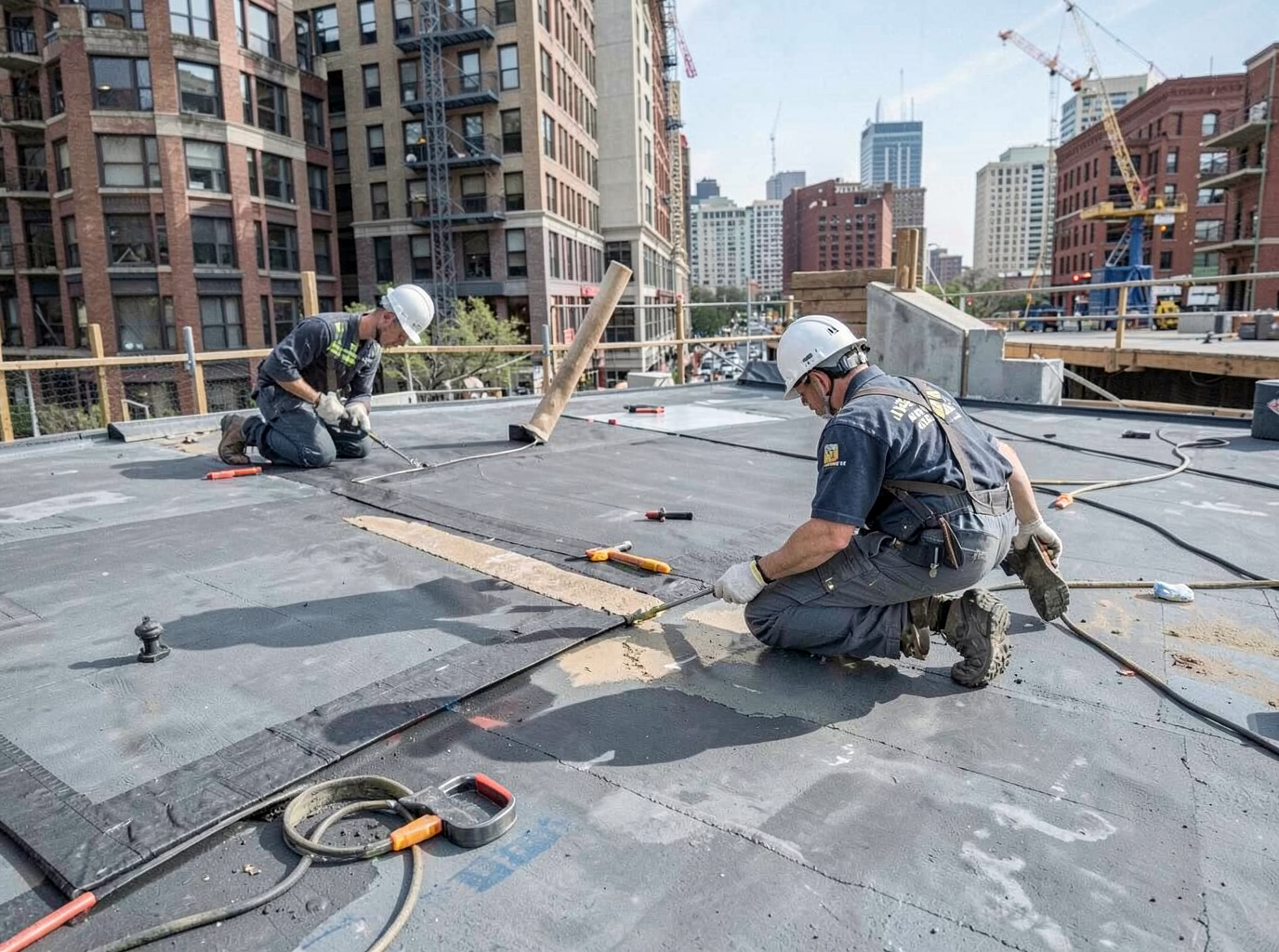
TPO is thermoplastic polyolefin, a single ply roofing membrane that now holds the largest share of the low-slope commercial market in the United States. Two properties explain that: the seams are hot air welded rather than glued, and the sheet is white and reflective. On a large flat roof over a conditioned building, both matter.
The welded seam is the more important of the two. Heat welding fuses the two sheets into a single mass of material, producing a bond as strong as the sheet itself when it is done correctly. On a big roof with long uninterrupted runs of seam, that strength is the property that determines how the roof performs. It is also the property that makes installation quality decisive, because a weld done at the wrong temperature or speed looks identical to a good one on the day and splits the first time the membrane goes through a hard temperature swing.
Thickness and construction
TPO is supplied in 45, 60 and 80 mil. Sixty mil is the commercial standard and the figure to expect on any serious specification. Forty-five mil exists, costs less, and produces a shorter lived roof.
The sheet is not homogeneous. A polyester reinforcing scrim sits between two layers of TPO compound, giving the membrane its tensile strength and puncture resistance. What matters for longevity is the thickness of the top ply above that scrim, since that layer takes the UV exposure and the foot traffic. Once it wears through to the scrim, the membrane is compromised regardless of the nominal thickness printed on the roll.
This is why a proposal that says TPO without saying a thickness is not yet a specification, and why walk pads along maintenance routes are worth their small cost.
Where it fails
Rarely in the open field. TPO fails at the hot air welded seams, and the failures concentrate in two places.
The first is along traffic paths. Service technicians walk the same routes to the same rooftop units year after year, compressing and abrading the membrane where it is already thinnest, and seams that cross those routes take the worst of it.
The second is anywhere the weld was made badly. Temperature, speed and roller pressure all have to be right, and a bad weld holds through a season before the first hard thermal cycle opens it. It is not visible as a defect at handover, which is one reason manufacturer inspection at completion exists.
Flashings are the third area, as on any membrane. Curbs, pipe boots, terminations and parapet details all have to turn corners and seal around obstructions, and they fail years ahead of the field.
Reflectivity and the energy question
The white surface reduces solar heat gain, which lowers summer cooling load. On a warehouse or distribution building measured in tens of thousands of square feet, particularly one running refrigeration, that is a real operating cost difference through a New Jersey July.
It is worth keeping in proportion. The benefit is smaller than the benefit of adequate insulation, and it is partly offset in winter when a dark roof gains useful heat. New Jersey sits in climate zone 4A and the energy subcode sets a minimum continuous insulation value for the assembly, which older buildings frequently do not meet. On a replacement, insulation is the item that has to be corrected and the item that does more for operating cost. Reflectivity is a genuine secondary benefit rather than the headline.
Attachment
The membrane is only half the assembly. How it attaches determines how it behaves under wind, and the options price differently.
Mechanically attached systems fasten through to the deck at intervals. They cost less and the membrane flutters under uplift, which on an exposed site accumulates stress at the fasteners and seams.
Fully adhered systems bond the membrane across its whole area. They cost more, do not flutter, and suit exposed sites and buildings where the deck or structure makes fastening problematic.
Ballasted systems hold the membrane with stone. They are limited by what the structure can carry and are less common on new commercial work.
Whichever is used, the assembly should carry a documented FM approval or UL uplift classification matched to the design wind speed for the site, with the fastening pattern tightened at perimeters and corners where uplift pressure concentrates. A building on an exposed industrial parcel and one sheltered on a dense block should not receive the same pattern.
Warranty
TPO manufacturers issue coverage in tiers, and the top tier, no dollar limit, pays repair labour and materials without a cap tied to the contract value. It generally requires installation by a certified applicator using that manufacturer's specified components, plus a manufacturer inspection at completion.
That last point has a practical consequence at bid stage. Substituting a cheaper insulation or a different fastener into the assembly to bring a number down can invalidate the coverage on the entire roof, and the owner usually discovers it at claim time rather than at signing. Later repairs also have to follow the manufacturer's method with the manufacturer's materials.
When TPO is the right answer
For most New Jersey low-slope commercial roofs it is the sensible default: retail, office, warehouse, distribution, light industrial, institutional.
Specify PVC instead where there is rooftop grease or chemical exhaust, since PVC resists oils and chemicals that break TPO down and the cost difference is worth it on those buildings. Consider EPDM where puncture resistance matters more than reflectivity, on roofs with heavy foot traffic or few penetrations. Modified bitumen suits roofs with dense equipment pads and constant maintenance access.
And on a building whose existing insulation is dry and which carries only one roof system, TPO installed as a recover over the existing assembly is frequently better value than a tear off.
For system by system comparison see flat commercial roofing, EPDM commercial roofing and metal commercial roofing. A commercial roof inspection with core sampling establishes whether a recover is available on your building. New installation and tear off work falls under commercial roof replacement, seam and flashing work under commercial roof repair, and the documented service record TPO warranties require under commercial roof maintenance.
Related reading: TPO vs EPDM vs PVC for New Jersey warehouse roofs and what a no dollar limit roof warranty actually covers.
TPO Commercial Roofing Services We Offer
✓TPO Installation
New TPO on new construction or over a stripped deck, with insulation and cover board specified to the energy subcode and a fastening pattern matched to the site's wind exposure.
✓TPO Recover Systems
TPO installed over the existing system with a cover board or new insulation between, where core samples confirm dry insulation and only one existing roof layer. Lower cost and faster than a tear off.
✓45, 60 and 80 Mil Specification
Sheet supplied in 45, 60 and 80 mil, with 60 mil the commercial standard. What governs longevity is the top ply thickness above the reinforcing scrim, since that layer takes the UV and the foot traffic.
✓Mechanically Attached Assemblies
Fastened through to the deck at intervals. Lower cost, and the membrane flutters under uplift, which accumulates stress at fasteners and seams on exposed sites.
✓Fully Adhered Assemblies
Membrane bonded across its whole area. Higher cost, no flutter, and the better answer on exposed sites or where the deck makes fastening problematic.
✓Hot Air Welded Seam Repair
Re-welding failed seams and patching punctures, using the manufacturer's method and materials where a warranty is still in force so the coverage stays intact.
✓Flashing and Termination Detailing
Curbs, pipe boots, terminations and parapet details, which fail years ahead of the field membrane because they have to turn corners and seal around obstructions.
✓Walk Pad Protection
Pads laid along the routes service technicians use to reach rooftop equipment, so the membrane is not compressed and abraded where seams cross those paths.
How it works
- 1
Establish what the roof can take
Core samples or an infrared scan establish what is on the roof now, how many layers it carries and whether the insulation beneath is dry. That determines whether TPO can go on as a recover or whether a full tear off is required, which is the largest cost decision on the project.
- 2
Specify the assembly
Sheet thickness, insulation thickness to meet the climate zone 4A continuous insulation requirement, cover board where the assembly calls for it, tapered insulation where drainage needs correcting, attachment method, and a documented FM or UL uplift classification matched to the site's design wind speed.
- 3
Confirm the warranty path
Which warranty tier the specified assembly qualifies for gets settled here rather than afterwards, along with whether the installation requires a certified applicator and a manufacturer inspection at completion. Substitutions made later to reduce cost can invalidate the coverage.
- 4
Permitting and staging
The construction permit is filed with the municipal construction official under the New Jersey Uniform Construction Code, with the building subcode technical section, product specifications and fastening details. Hoisting, dumpster placement and sequencing are planned so the building is never left with a large area of open deck.
- 5
Installation
Removal where required, deck repair, insulation and cover board, then the TPO membrane hot air welded to the specified fastening pattern, with flashing and termination detailing at every penetration. Work is sectioned so the building stays weather tight.
- 6
Inspection and handover
Seams, flashings, terminations and drains inspected with you, the manufacturer inspection arranged where the warranty requires one, and the documentation handed over: assembly specification, warranty paperwork, permit sign off and the maintenance schedule that keeps the coverage valid.
Pricing
TPO pricing turns on the specification rather than the membrane name. Roof area comes first, then whether the job is a recover over the existing system or a full tear off with disposal, then sheet thickness, the insulation needed to meet the energy subcode, whether tapered insulation is required to correct drainage, the attachment method, the uplift rating the site calls for, and access and staging. The warranty tier is part of it too, since no dollar limit coverage requires a certified applicator and a manufacturer inspection. Quotes follow an on site assessment with core samples.