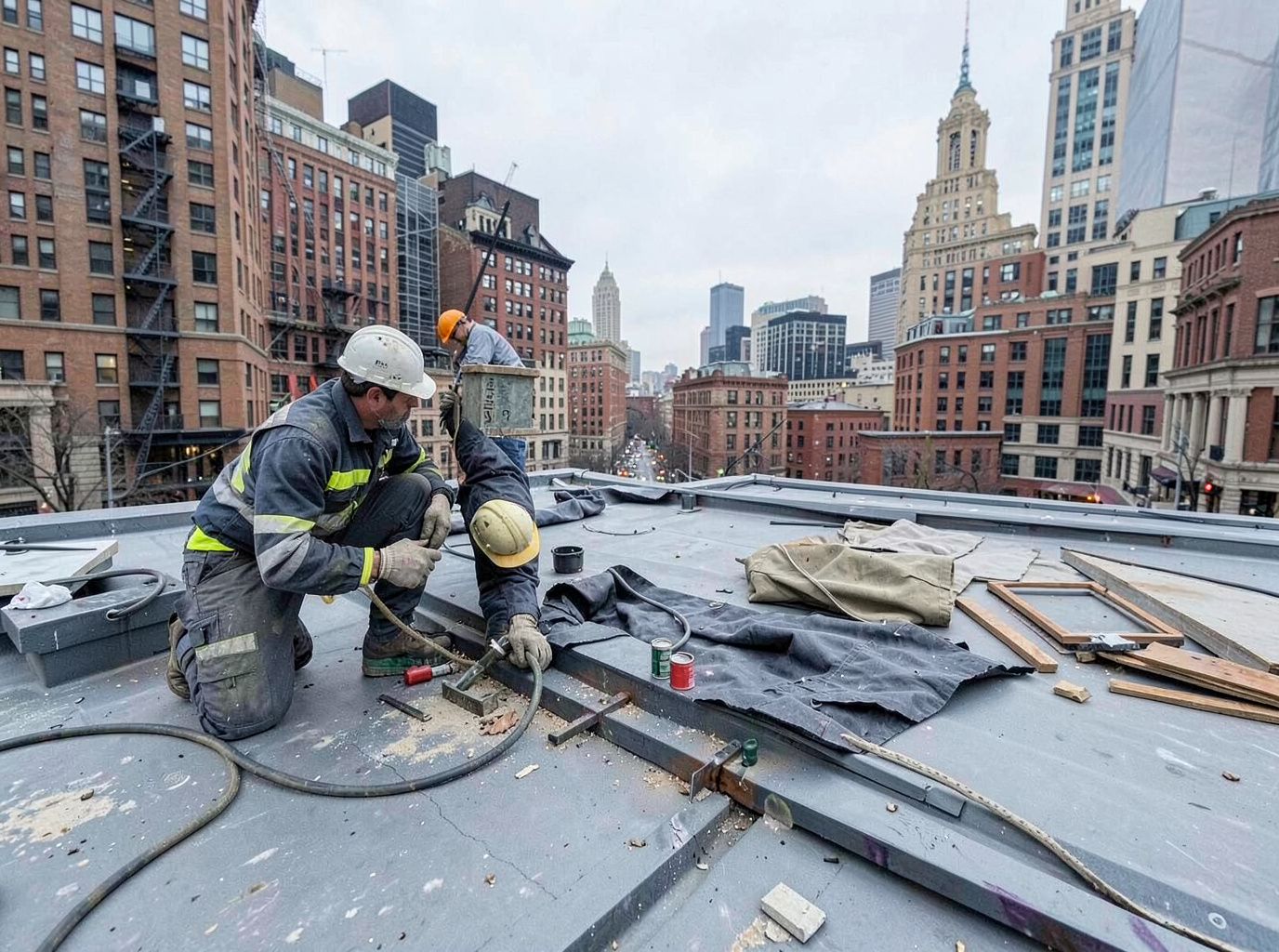
South Plainfield's industrial parks along US-22 and NJ-27 carry a mix of aging flat-roof warehouses and distribution facilities, many with membrane systems that have taken a beating from the area's hot, humid summers and freeze-thaw winters. That combination stresses seams and flashing over time, and buildings near I-287 see extra wear from vibration and airborne debris kicked up by highway traffic. Roofs near Spring Lake Park and the industrial corridor often show ponding water issues on low-slope sections, a common precursor to full replacement rather than patch repairs. Given the density of manufacturing and logistics buildings in town, replacement work here typically means coordinating around active loading docks and staggered shifts rather than a simple tear-off.
Commercial Roof Replacement in South Plainfield — What We Handle
- ✓Heavy concentration of industrial and warehouse flat roofs needing membrane-specific replacement plans
- ✓Highway-adjacent buildings near I-287 and US-22 face added wear from traffic vibration and debris
- ✓Scheduling replacement around active industrial operations and shift patterns is standard here
Commercial Roof Replacement Services We Offer in South Plainfield
✓TPO Roof Replacement
Reflective heat welded single ply, the most common choice for flat commercial roofs in this climate. Available in 45, 60 and 80 mil, with 60 mil the usual specification on commercial work.
✓PVC Roof Replacement
The system to specify on restaurants and any building with rooftop grease exhaust, because PVC resists the oils and chemicals that degrade other membranes. Also common on buildings with chemical discharge nearby.
✓EPDM Roof Replacement
Rubber membrane suited to older masonry buildings with few rooftop penetrations, where puncture resistance and long service life matter more than reflectivity.
✓Modified Bitumen Replacement
Torch applied or cold applied systems built for roofs carrying heavy foot traffic, dense equipment pads, or frequent maintenance access.
✓Built-up Roof (BUR) Replacement
Multi ply replacement for older industrial and warehouse buildings where a like for like system is the right answer, including gravel surfaced assemblies.
✓Roof Recover Systems
New membrane installed over the existing system with a cover board or new insulation between, where core samples confirm the insulation is dry and the building is not already carrying two roof systems. Lower cost and faster than a full tear off.
✓Tear Off and Deck Repair
Complete removal down to the deck with inspection for rot, corrosion and failed fasteners, and structural repair where the deck has been compromised, before any new assembly goes down.
✓Insulation Upgrades to Energy Code
Added polyiso thickness to meet the continuous insulation requirement for climate zone 4A, with cover board where the assembly calls for it, specified as its own line in the quote.
✓Tapered Insulation and Drainage Correction
Re-sloping with tapered polyiso and upsizing or relocating drains and scuppers, so an existing ponding problem does not carry over onto the new roof.
✓Rooftop Equipment Curb Work
Reinforced flashing and curb detailing around HVAC units, exhaust fans, vent stacks and equipment pads, plus removal of abandoned penetrations that were never sealed properly.
Replacing a commercial roof is a different discipline from residential work rather than a larger version of it. Most flat and low-slope buildings across New Jersey are running built-up roofing, modified bitumen, or EPDM that has outlived its service life, and by the time a property manager calls, years of ponding water have often already reached the deck. The sequence that matters is: find out what is up there, find out whether the insulation is dry, then talk about membranes. Choosing a system before anyone has cut a core sample is how projects end up with the wrong assembly on a compromised deck.
That core sample also decides the single biggest cost question on any replacement, which is tear off versus recover. A tear off removes everything down to the deck. A recover installs a new membrane over the existing system, usually with a cover board or fresh insulation between the two. Recover costs less, moves faster and sends far less to the landfill, but it is only available where the existing insulation is dry and where the building is not already carrying two roof systems. A third layer is not permitted and loads a deck that was never designed for it. Where a recover is genuinely an option, it is usually the better value. Where it is not, saying so early saves everyone a wasted conversation.
How It Works in South Plainfield
- 1
On site assessment and core sampling
We walk the roof, check the deck from below where it is accessible, and document membrane condition, drainage, equipment layout and perimeter detailing. Core samples or an infrared scan establish whether the insulation is dry, which is what determines the options available.
- 2
Tear off or recover decision
Based on what the cores show, we lay out whether a recover is possible or whether a full tear off is required, and what each would involve. This is the largest single cost decision on the project and it gets made on evidence rather than preference.
- 3
System specification and proposal
We recommend a membrane system based on the building's use, roof traffic and exposure, specify the insulation needed to meet the energy subcode, confirm the wind uplift rating required for the site, and set out which warranty the assembly qualifies for. The proposal is itemized so you can see what each element costs.
- 4
Permitting and staging plan
We file the construction permit with the municipal construction official under the New Jersey Uniform Construction Code, including the building subcode technical section and product specifications. Alongside that we plan hoisting, dumpster placement, access and sequencing so the building is never left with a large area of open deck.
- 5
Installation
Removal to the deck where required, repair of any rotted or corroded sections, then insulation, cover board, membrane, flashing and drainage corrections installed to the specified assembly and fastening pattern. Work is sectioned so the building stays weather tight throughout.
- 6
Final inspection and handover
We inspect seams, flashing, terminations and drains with you, arrange the manufacturer inspection where the warranty requires one, and hand over the documentation: the assembly specification, warranty paperwork, permit sign off and a maintenance schedule to keep the coverage valid.
Serving All of South Plainfield
We regularly handle commercial roof replacement jobs near:
- 📍Spring Lake Park
- 📍South Plainfield Public Library
- 📍Plainfield Country Club
- 📍Downtown South Plainfield
- 📍New Market
Commercial Roof Replacement Pricing in South Plainfield
Replacement pricing is driven by roof area, deck condition, and whether the job is a recover over the existing system or a full tear off with disposal. On top of that: membrane type and mil thickness, how much insulation has to be added to meet the energy subcode, whether tapered insulation is needed to correct drainage, the attachment method and wind uplift rating for the site, and how difficult access and staging are. Two roofs of the same size can price very differently once those are accounted for. Every quote is written and itemized after an on site assessment, never estimated over the phone.
Want the full picture of this service? See our Commercial Roof Replacement page, or everything we do in South Plainfield, NJ.