Metal roofs fail differently from membranes, and the difference comes down to movement. A metal panel expands and contracts measurably between a hot afternoon and a cold night, and it does that every day for decades. Everything that goes wrong on a commercial metal roof traces back to where that movement is absorbed, or where it is not.
That is also why commercial metal roof repair is a different job from membrane repair. The failure points are fasteners, panel end laps, clips, closures and trim rather than seams and flashing, and diagnosing them requires knowing which system is on the building.
Two systems, two failure modes
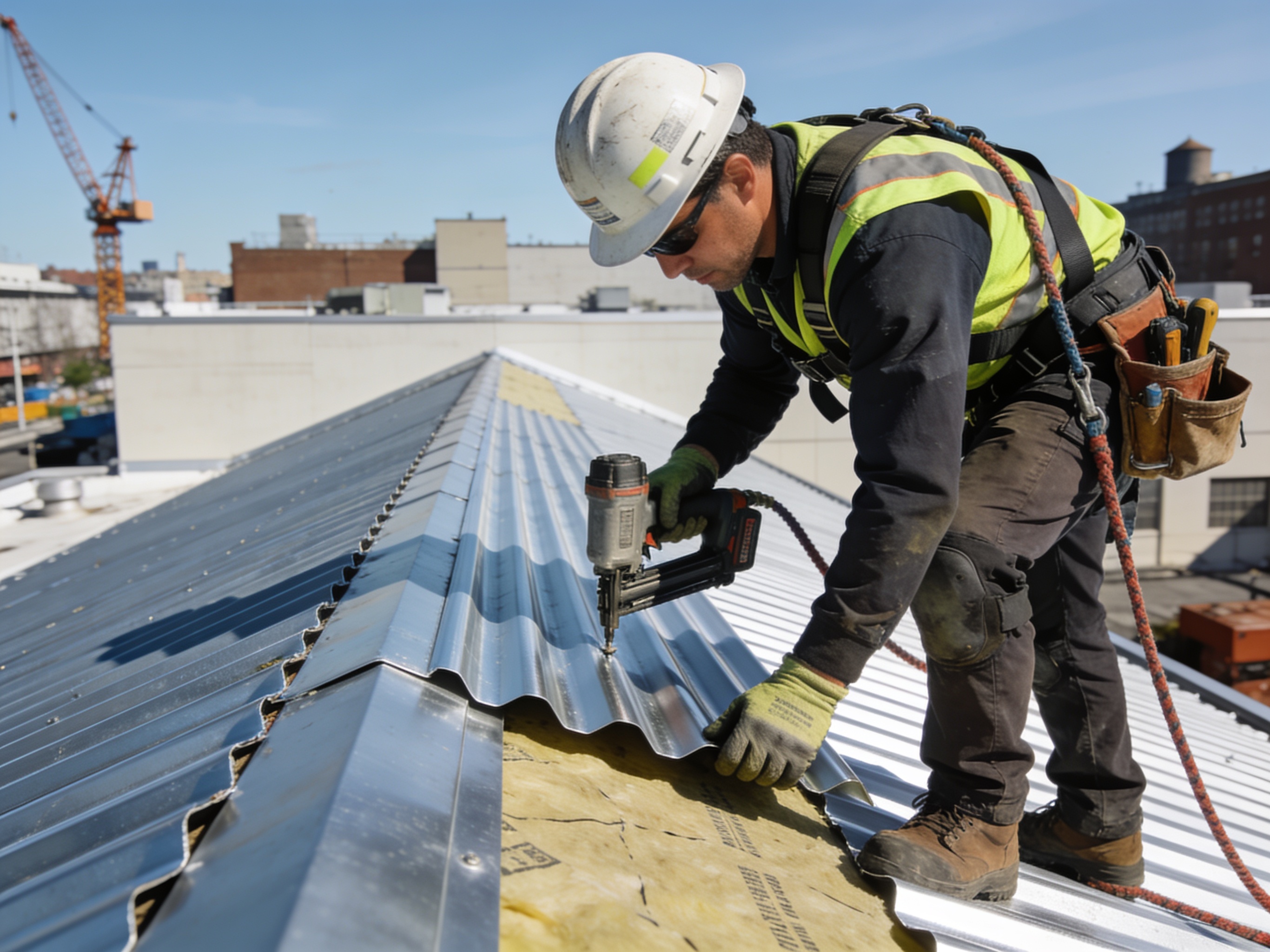
Exposed fastener panels, including R-panel and corrugated profiles, screw through the face of the panel into the purlins beneath. They are cheaper to install and they are still on a large share of New Jersey warehouse and light industrial buildings from the 1980s and 1990s.
They fail at the fasteners. Thermal movement works the screws loose over the years, and the neoprene washer under each head hardens and cracks. Water then enters at the hole. Rust streaking below a screw head is the classic symptom, and it almost always means a fastener problem rather than a failed panel. Re-fastening with oversized screws and new washers on a cycle is what keeps these roofs going, and skipping that maintenance is the most common reason these buildings produce emergency leak calls after a hard freeze.
Standing seam joins panels at a raised vertical rib with no fasteners through the face, held by concealed clips. It costs more, lasts longer and is standard on newer commercial work.
It fails at the clips, the seams and the terminations. Floating clips are designed to let the panel move; if the clips were not specified for the panel length, the movement has nowhere to go and you get oil canning across the face and eventually seam separation at the ridge. Ridge caps, eave and gable trim, and closure strips are the other recurring leak points.
On both systems, rooftop penetrations are where a disproportionate number of leaks actually originate. HVAC curbs, conduit runs and vents added after the original installation are frequently fastened through the panel without being flashed into the system.
Corrosion
Galvalume and galvanised panels resist corrosion across the face, but the sheared edge is exposed metal and so is every fastener head. That is where it starts. Red rust at cut edges and around fasteners spreads under the coating from those points, and on buildings near the coast salt in the air accelerates it noticeably.
The coating itself matters too. PVDF finishes hold colour and resist chalking longer than SMP finishes, which is worth knowing when a roof is being specified rather than after twenty years of fade.
Hybrid and coated systems
On low-slope commercial buildings, metal decking is often the structural base rather than the finished surface, and what sits above it is a coated metal panel or a membrane over standing seam. Coating breakdown at seams and pitch pans is the usual failure point on those, and it gets misdiagnosed as a membrane issue when the metal underneath is corroding.
Any repair scope on a hybrid system needs a thickness check on the deck before anyone commits to a patch. A coating applied over a substrate failing from beneath does not last, and the money is wasted.
Repair, recoat, retrofit or replace
Four options, and the substructure decides which is available.
Commercial metal roof repair covers fastener replacement, seam and clip work, closure and trim replacement, and re-flashing penetrations. Where panels and coating are sound, this is usually the right answer and it is a fraction of replacement cost.
Recoating restores the weather barrier on a roof with surface corrosion and sound panels. Seams and fastener heads get detailed first, then a silicone or acrylic system goes over a properly prepared surface. Preparation is most of the job, and a coating over active rust will not bond.
Retrofit frames a new roof over the existing one, typically converting old exposed fastener panels to standing seam using sub-purlins, sometimes adding insulation in the cavity. It avoids a full tear off and keeps the building enclosed throughout, which on an occupied warehouse is worth a great deal. It requires the structure to carry the extra load.
Commercial metal roof replacement is the answer when purlins or deck are corroded through. That is a structural liability rather than a roofing one, and patching over it is not a service worth buying.
A scope on any New Jersey commercial metal roof should include a written note on what was found underneath, not only what is visible from the ground.
Where to go from here
A commercial roof inspection establishes panel gauge, fastener and coating condition, and the state of the substructure, which is what decides between the four options above. For low-slope membrane systems see flat commercial roofing, TPO commercial roofing and EPDM commercial roofing.
For active water coming in, commercial roof leak repair covers detection and emergency response. Ongoing fastener and sealant cycles fall under commercial roof maintenance, and full tear off and reinstall under commercial roof replacement.
Metal Commercial Roofing Services We Offer
✓Exposed Fastener Re-fastening
Replacing backed-out screws and hardened neoprene washers on R-panel and corrugated systems with oversized fasteners, which is the single most common commercial metal roof repair and the one that prevents most leak calls.
✓Standing Seam and Clip Repair
Clip failure, seam separation at the ridge, and oil canning caused by clips that were never specified for the panel length. Repaired without disturbing panels that are still sound.
✓Trim, Ridge Cap and Closure Replacement
Ridge caps, eave and gable trim, and closure strips, which are recurring leak points on both panel types and are frequently overlooked in favour of the panels themselves.
✓Rooftop Penetration Flashing
Re-flashing HVAC curbs, conduit runs, vents and equipment added after the original installation, which is where a disproportionate share of metal roof leaks actually originate.
✓Metal Roof Coating and Recoating
Silicone or acrylic coating over a properly prepared surface, with seams and fastener heads detailed first, restoring the weather barrier on roofs with sound panels and surface corrosion.
✓Metal Retrofit Roofing
New standing seam framed over an existing exposed fastener roof using sub-purlins, often with insulation added in the cavity. Avoids a tear off and keeps the building enclosed, subject to the structure carrying the load.
✓Coated and Hybrid Metal Systems
Repair and recoating of coated metal panel systems and membrane over standing seam assemblies, where coating breakdown at seams and pitch pans is commonly misdiagnosed as a membrane fault.
✓Panel and Substructure Thickness Testing
Magnetic thickness testing on the deck plus assessment of purlins, girts, panel gauge and cut edge corrosion, which is what determines whether repair is viable or replacement is the responsible call.
✓Storm and Wind Damage Repair
Response for lifted panels, blown ridge caps and wind damage, with the damage photographed and documented at the time for an insurance claim before anything is put back.
How it works
- 1
Identify the system and assess the panels
We establish whether the system is exposed fastener or standing seam, check panel gauge and profile, and assess fastener condition, washer state, coating integrity and corrosion at cut edges. Seams, clips, closures, ridge and eave trim and every penetration get inspected.
- 2
Check the substructure
A magnetic thickness check on the deck and a look at the purlins and girts establishes whether the substructure is sound. This is the finding that decides whether repair, recoating and retrofit are on the table at all, or whether replacement is the only responsible answer.
- 3
Written diagnosis and options
You get a plain explanation of what is failing and why, with photographs, and a written scope setting out which of repair, recoating, retrofit or replacement fits the roof and what each would involve. The reasoning is included, not just the recommendation.
- 4
Upfront quote
An itemised quote before anything starts, covering materials, labour and any substructure work. Where something is found on opening up that was not visible during the assessment, it gets discussed with you before the work continues.
- 5
Repair, recoat, retrofit or replace
Fastener and washer replacement, seam and clip work, closure and trim replacement, penetration re-flashing, coating application over a prepared surface, retrofit framing, or tear off and reinstall, matched to the existing system and specified for the site's wind exposure.
- 6
Final walkthrough and documentation
We walk the completed work with you, confirm drainage paths and penetrations, and hand over photographs and notes covering what was found and what was done, along with anything worth monitoring on the next cycle.
Pricing
Metal roof repairs generally cost less per square foot than membrane repairs, because re-fastening a section or replacing closures and trim is far less work than cutting out and welding membrane. Full metal roof replacement runs higher than a low-slope reroof, since panels, clips and often substructure are involved. What moves the number is panel gauge and profile, how much of the substructure is sound, whether a retrofit over the existing roof is possible, roof access, and how much of the deck needs replacing. Quotes follow an on roof assessment with a thickness check, not a phone call.