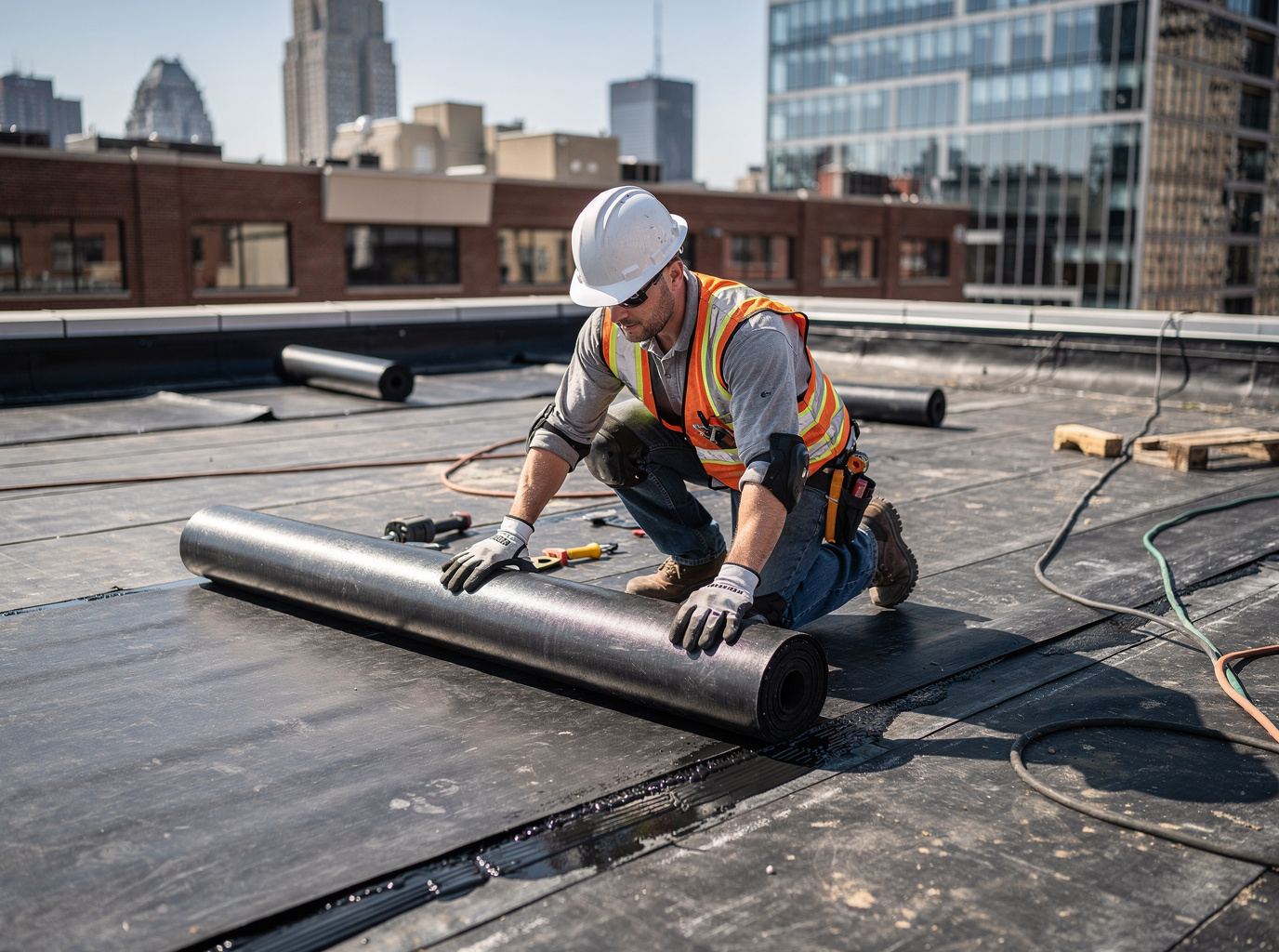
EPDM is ethylene propylene diene monomer, a synthetic rubber membrane that has been on commercial buildings in this country since the 1960s and covers a large share of everything re-roofed through the 1990s and 2000s. If a New Jersey commercial building has a black rubber roof, this is almost certainly what it is.
It is a thermoset rather than a thermoplastic, which is the source of both its strengths and its one significant weakness. Thermoset means the material cures and cannot be re-melted, so its seams cannot be heat welded the way TPO and PVC seams are. They are bonded with adhesive or tape instead.
What EPDM is good at
Longevity and toughness. EPDM handles UV, ozone and temperature cycling well, and a properly installed roof routinely reaches 25 to 30 years or more. It resists punctures better than the thermoplastics, which matters on roofs carrying heavy foot traffic, frequent maintenance access or wind blown debris.
It also performs particularly well on roofs with few penetrations. Its main weakness is seam count, so a large open field with little rooftop equipment plays to its strengths, while a cluttered roof with dense plant plays to its weaknesses.
It is available in 45, 60 and 90 mil. Sixty mil is the common commercial specification, and 90 mil is used where puncture resistance is the priority.
Where EPDM fails
The seams. Because they are adhesive or tape bonded rather than welded, the seam is the weakest part of the assembly rather than the strongest, which is the reverse of TPO and PVC. Tape systems have improved substantially over the older adhesives, but on a roof with long seam runs the seams remain the point that needs watching. T-joints, where three sheets meet, take particular attention.
Shrinkage. This is the defining characteristic of an ageing EPDM roof. The sheet contracts over the years and pulls in from the edges, putting tension on every perimeter and curb flashing. Symptoms are flashing lifting at parapets, membrane visibly stretched at corners, and terminations pulling away from the bar. It is progressive, so the sooner it is addressed the less flashing has to be rebuilt. A roof shrinking badly across the entire perimeter is generally at the end of its life rather than needing another repair.
Flashings and penetrations, as on any membrane. Curbs, pipe boots and terminations fail years ahead of the field.
EPDM commercial roof repair
Repairing EPDM correctly means working to the material rather than to a generic method, and this is where a lot of repairs go wrong.
Seam repairs mean cleaning back to sound material, priming, and applying new splice or cover tape over the joint. Punctures and tears get a patch with rounded corners, primed and rolled, because square corners lift. Shrinkage at a parapet usually means the flashing has to be released and rebuilt with new uncured flashing rather than pulled back and stuck down again.
Using the wrong primer, or a general purpose sealant that was never designed for EPDM, is a common reason a repair looks fine on the day and fails within a year. Where a manufacturer warranty is still in force, the repair also has to follow that manufacturer's method and materials or the coverage on the whole roof can be affected.
Colour and energy
Standard EPDM is black and absorbs solar heat rather than reflecting it. On a large conditioned building in New Jersey that works against you through the summer and is mildly helpful in winter. White EPDM exists and costs more.
Where reflectivity is a priority, a white thermoplastic is usually the more direct answer, and EPDM gets chosen for its other properties instead. Insulation still matters more than membrane colour on either count, and New Jersey sits in climate zone 4A where the energy subcode sets a minimum continuous insulation value that older buildings frequently do not meet.
Attachment and ballast
EPDM is installed mechanically attached, fully adhered or ballasted, and the assembly should carry a documented FM or UL uplift classification matched to the design wind speed for the site.
Ballasted systems, stone laid over a loose membrane, were common on older installations. The stone protects the sheet from UV, which is why some ballasted roofs last unusually well, but it hides the membrane completely. Leaks are difficult to trace and the roof cannot be inspected without moving stone. Ballast load is limited by structural capacity, and replacing a ballasted roof means removing and disposing of a great deal of stone, which belongs on the quote as its own item.
When EPDM is the right choice
On roofs where puncture resistance and long service life matter more than reflectivity, on buildings with few rooftop penetrations, and where the existing system is EPDM and a like for like recover makes sense.
Specify a white thermoplastic instead where cooling load is the priority, PVC where there is rooftop grease or chemical exhaust, and modified bitumen where dense equipment pads and constant maintenance traffic are the defining condition.
For comparison across systems see flat commercial roofing, TPO commercial roofing and metal commercial roofing. A commercial roof inspection with core sampling establishes the condition of the sheet, the extent of any shrinkage and whether the insulation beneath is dry.
For seam and flashing work see commercial roof repair, for active water intrusion commercial roof leak repair, for tear off and recover commercial roof replacement, and for the sealant and termination cycle that keeps an EPDM roof going, commercial roof maintenance.
Related reading: TPO vs EPDM vs PVC for New Jersey warehouse roofs.
EPDM Commercial Roofing Services We Offer
✓EPDM Seam Repair
Cleaning back to sound material, priming and applying new splice or cover tape across failed adhesive or tape bonded seams, with particular attention to T-joints where three sheets meet.
✓Puncture and Patch Repair
Patching punctures and tears with rounded corners, primed and rolled, since square corners lift. Materials matched to the sheet and to the manufacturer's method where a warranty is still in force.
✓Shrinkage and Flashing Rebuild
Releasing and rebuilding perimeter and curb flashing where the sheet has contracted and pulled in from the edges, using new uncured flashing rather than stretching the existing material back into place.
✓Penetration and Termination Detailing
Re-flashing curbs, pipe boots, terminations and conduit stands, which fail years ahead of the field membrane on any EPDM roof.
✓EPDM Installation
New EPDM in 45, 60 or 90 mil, installed mechanically attached, fully adhered or ballasted according to the deck, the structure and the site's wind exposure.
✓EPDM Recover Systems
New EPDM over the existing system where core samples confirm dry insulation and only one existing roof layer, which costs less and creates far less disposal than a tear off.
✓Ballasted System Work
Assessment, repair and replacement of stone ballasted assemblies, including the removal and disposal of ballast, which is a significant item in its own right and belongs on the quote separately.
✓Wet Insulation Removal
Cutting out and replacing polyiso and cover board that has taken on water, so new work sits on a dry substrate rather than trapping moisture underneath the sheet.
How it works
- 1
Identify the system
We confirm the sheet thickness and attachment method, whether the system is ballasted, and how the seams were made, since adhesive bonded seams from older installations are repaired differently from modern tape systems. On ballasted roofs, stone has to be moved to see anything at all.
- 2
Assess seams, flashings and shrinkage
Seams and T-joints, perimeter and curb flashings, terminations, pipe boots and penetrations, plus the extent of any shrinkage pulling the sheet in from the edges. Shrinkage is progressive, so how far it has gone is one of the more useful findings on an ageing EPDM roof.
- 3
Check the insulation beneath
Core samples or an infrared scan establish whether the insulation beneath is dry. That answer decides whether a repair will hold, whether a recover is possible, or whether wet material has to come out first. Nothing meaningful can be quoted before it.
- 4
Repair, recover or replace recommendation
Isolated seam, patch and flashing failures over dry insulation are a repair. Widespread shrinkage across the perimeter, extensive seam failure, or wet insulation across a large share of the roof means a recover or a tear off, and we will say so rather than sell another patch.
- 5
Repair to the material
Seam repairs cleaned back, primed and taped, patches with rounded corners primed and rolled, and shrinkage flashing released and rebuilt with new uncured flashing. Materials and method follow the manufacturer's specification where a warranty is still in force.
- 6
Verification and documentation
The repaired area and surrounding drainage get tested, and you receive photographs and written notes covering what was found and what was done, for your records or a warranty file.
Pricing
EPDM repair pricing depends on what is failing. A seam or patch repair on an accessible roof sits at the low end. Rebuilding shrinkage-damaged flashing around a perimeter is considerably more, because the work runs the length of every affected edge rather than sitting in one spot. Replacement pricing turns on roof area, deck condition, whether the job is a recover or a full tear off, sheet thickness, insulation needed to meet the energy subcode, attachment method and uplift rating, and on ballasted roofs the removal and disposal of the stone. Quotes follow an on roof assessment with core samples.