
2026-08-17 · Mike Dalton
When to Choose Repair Over Full Replacement for Flat Roofs
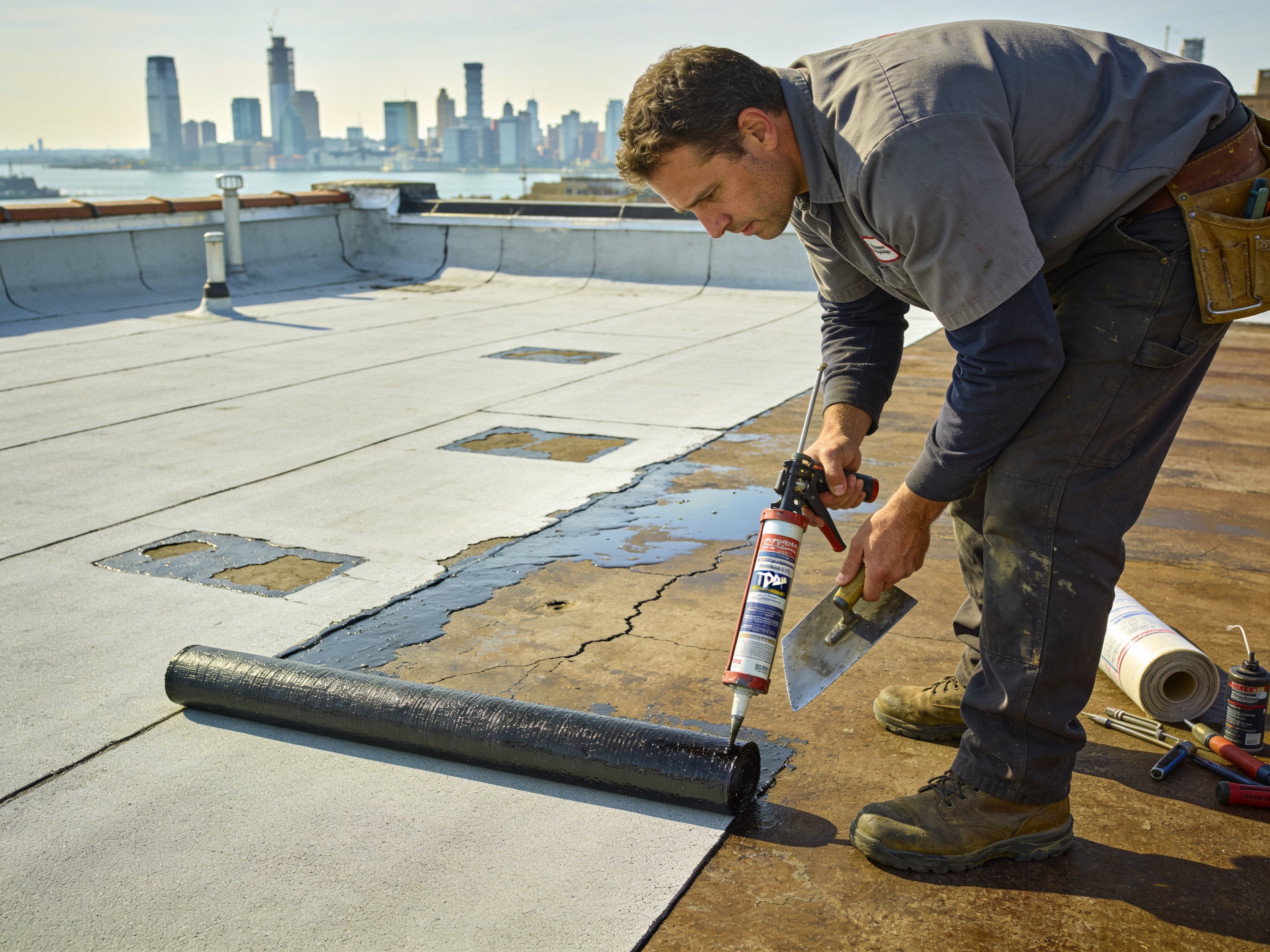
As a rule we follow on jobs from Journal Square to Liberty Harbor: if a flat roof is under 15 years old, damage is confined to one or two areas, and the insulation underneath is still dry, repair almost always makes sense — typically $400 to $3,500 depending on membrane type and access. Once a roof passes 18-20 years, or damage shows up in three or more separate spots, replacement usually pencils out cheaper over a 5-year horizon than chasing leaks one at a time.
That threshold isn't arbitrary. It's what we see when we cut test squares into TPO and EPDM roofs across Hudson County — the membrane itself might look fine on top while the insulation board underneath has gone soft and waterlogged. A patch on wet insulation fails again within a season. A patch on dry insulation with a sound membrane can genuinely add years to a roof's life.
Signs a Repair Will Actually Hold
Not every leak means the roof is done. These are the situations where a targeted repair is the right call and will last:
- Localized punctures or splits — from foot traffic, dropped tools, or storm debris — in a membrane that's otherwise flexible and well-adhered
- Failed flashing at penetrations (vents, HVAC curbs, drains) rather than field membrane failure
- Seam separation in one or two spots on TPO or EPDM where the rest of the seams still pass a probe test
- Ponding water that's a drainage/slope issue, not membrane breakdown, and can be corrected with tapered insulation or additional drains
- Roof is under 15 years old with no widespread granule loss, blistering, or brittleness
If your building sits near Newport or Exchange Place with rooftop mechanical units, penetration flashing is almost always the first thing to fail — not the field membrane itself. That's a repair, not a replacement problem, and it's usually resolved in a single service visit. Our commercial roof leak repair work covers exactly this category more often than any other call we get.
When Replacement Is the Honest Answer
There's a point where repair stops being cost-effective and starts being a way to delay an inevitable, larger bill. We tell owners it's time to replace when:
- The roof is 20+ years old and has already had 3 or more patch repairs in the last 5 years
- Insulation is wet across more than 25% of the roof area — confirmed by core cuts or infrared moisture scan
- Membrane shows widespread shrinkage, blistering, or brittleness, not just isolated damage
- You're seeing interior ceiling stains in multiple rooms rather than one consistent spot
- The building is changing use or adding rooftop equipment that the current roof structure or drainage wasn't designed for
In these cases, patching buys a few months at best, and the next storm — Jersey City's humid subtropical climate means hot, humid summers followed by freeze-thaw winters that stress membranes twice a year — finds the next weak point. A full commercial roof replacement at that stage, whether TPO, EPDM, or a modified bitumen system, resets the clock and usually comes with a more predictable maintenance schedule going forward.
What an Honest Assessment Looks Like
Before we recommend either path, we walk the roof and check a few specific things: seam integrity with a probe, insulation moisture with a core cut or infrared scan, drain and scupper condition, and flashing at every penetration. We also ask how old the roof actually is — building records in older Bergen-Lafayette and Greenville properties don't always match what's on the roof, since re-covers sometimes get layered without full tear-off. A proper commercial roof inspection documents all of this with photos, so the repair-vs-replace decision is based on evidence, not guesswork.