
2026-08-28 · Mike Dalton
Why Ponding Water Is the Leading Cause of Flat Roof Failure
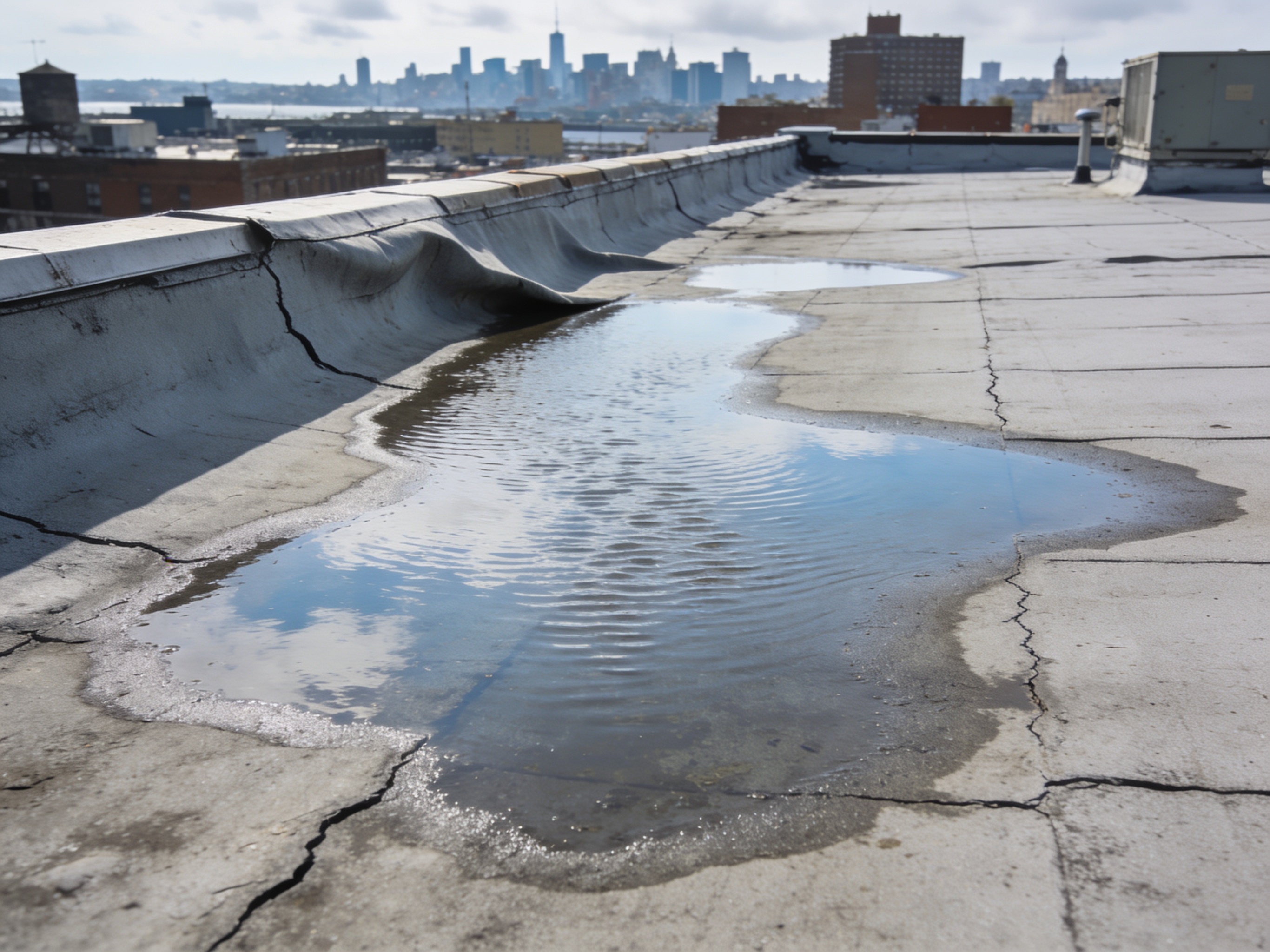
Standing water on a flat roof looks harmless. It is the reason a large share of low-slope commercial roofs fail years before they should, and it is behind most of the repeat leaks that get patched two or three times in the same spot without ever being fixed.
The 48 hour rule
Low-slope roofs are not designed to be dry immediately after rain. They are designed to drain. The industry threshold is 48 hours: water that remains on the roof more than 48 hours after rainfall has stopped, under conditions that allow drying, is ponding rather than normal drainage lag.
That number is not arbitrary. Below it, water leaves before it does meaningful harm. Above it, the roof is holding a load and a chemical exposure it was not designed for, continuously, every time it rains.
The practical test is simple. Two days after a storm, walk the roof. Anywhere still holding water, or showing the dirt ring and silt deposit that marks where water sat, is a ponding area whether or not it is wet at that moment.
What the water is actually doing
Ponding damages a roof through several mechanisms at once, which is why it accelerates failure faster than the sum of its parts would suggest.
Weight. Water weighs roughly 5.2 pounds per square foot per inch of depth. An inch of standing water across a 40 by 40 foot area is over 8,000 pounds. That load causes the deck to deflect slightly, which deepens the low spot, which collects more water. The process compounds. On roofs where this has run for years, the depression is visible from the ground.
Chemical and UV exposure. Standing water concentrates whatever it holds. Dust, pollutants, biological growth and the granules shed by the roof itself sit in the pond rather than washing off. On asphalt based systems this accelerates breakdown directly. On single ply membranes the effect is slower but real, particularly where the pond sits over a seam.
Seams and laps. A seam that is sound under running water can fail under constant hydrostatic pressure. Water sitting on a lap for days at a time finds any weakness in the weld or adhesive, and once it is under the membrane it spreads laterally where no inspection will see it.
Freeze and thaw. In New Jersey this is the one that finishes the job. Water that has worked into a seam or a crack expands when it freezes, widens the opening, then melts and goes deeper. A pond that was a slow problem in October becomes an active leak by February.
Biological growth. Persistent water grows algae and, on roofs with any organic debris, vegetation. Roots find their way into seams. This is a slower process than the others but on neglected roofs it is not unusual.
Why it causes repeat leaks
This is the part that costs owners the most money, because it produces a specific and expensive pattern.
A leak appears. A contractor patches the membrane where the water is entering. Six months later it leaks again, a short distance from the last patch. Another patch. Then again.
Nothing was ever fixed, because the membrane was never the problem. The pond is still there, still loading the same area, still working into whatever seam is next weakest. Each patch treats a symptom of a drainage fault and buys a season.
There is a second version of this that is worse. If the pond has been there long enough that the insulation underneath has taken on water, a patch is being applied over a saturated substrate. Wet polyiso does not dry out on its own. The new patch has nothing sound to bond to and the wet area continues spreading under the membrane, corroding the deck and destroying the assembly's R-value while the roof looks acceptable from above.
By the time this is discovered, the question is no longer repair. It is how much of the roof has to come off.
Why the drainage is inadequate in the first place
Ponding usually has one of four causes, and they need different fixes.
Blockage. Debris, leaf fall, granules and silt in the drains, scuppers or gutters. This is the most common cause and the easiest to fix, and it is the reason drain clearing is the highest value item on a routine maintenance visit.
Undersized or badly placed drainage. Plenty of older commercial buildings were built with drains sized for different rainfall assumptions than we work with now, or placed where the roof does not actually drain to. No amount of clearing fixes this. It needs additional or relocated drainage.
Insufficient slope. Flat roofs are supposed to have a slight pitch toward the drains. Some were built without enough, and some have lost it through deck deflection over decades. This is corrected with tapered insulation, which is a replacement scale intervention rather than a repair.
Deck deflection. Structural sag, sometimes caused by the ponding itself, sometimes by rooftop equipment added after construction without checking the structure. This is a structural question before it is a roofing one.
Distinguishing between them matters because the cost range is enormous. Clearing a blocked drain is a maintenance visit. Re-sloping a roof with tapered insulation is a major project.
What to actually do
For any roof currently holding water, the sequence is: establish how long it sits, identify which of the four causes applies, and find out whether the insulation underneath is still dry.
That last item decides everything. Core samples or an infrared scan will answer it, and the answer determines whether you are looking at a drainage correction or a drainage correction plus removal of saturated insulation.
For roofs not currently ponding, the protection is routine drain clearing twice a year, timed for spring and autumn. Autumn matters more than most owners expect, because leaf fall and blown debris settle into the drains through October and November. A drain that backs up in December does not simply pond. It freezes, and the water then spreads across the field of the roof instead of leaving it.
The economics
Clearing drains costs very little and takes an hour. Correcting slope with tapered insulation costs a great deal and usually happens as part of a replacement. Removing saturated insulation across a large area costs more still, and it is the point at which repair stops being viable at all.
The gap between those numbers is why ponding is worth taking seriously while it is still just water sitting on a roof.
If your roof holds water after storms, a commercial roof inspection will establish the cause and whether the insulation is still dry. Routine drain clearing is part of a commercial roof maintenance programme, and where the water has already caused damage, commercial roof leak repair covers detection and wet insulation removal. Where slope correction is the answer, that falls under commercial roof replacement. Newark building owners can see why this matters locally on commercial roof maintenance in Newark and commercial roof leak repair in Newark.
Related reading: how to read a commercial roof replacement bid.