
2026-08-28 · Mike Dalton
TPO vs EPDM vs PVC for New Jersey Warehouse Roofs
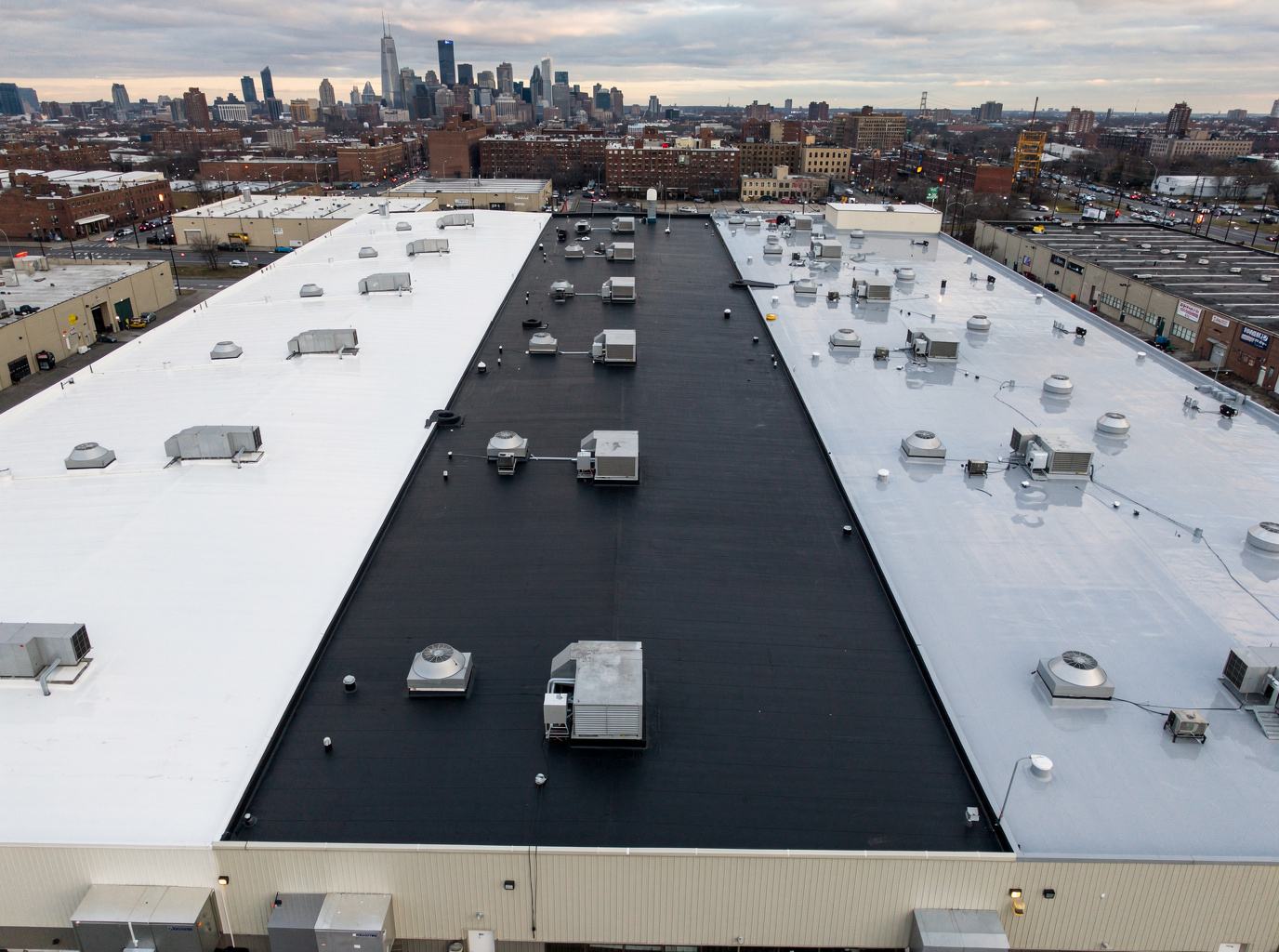
Warehouse and distribution roofs are a different problem from the rest of the commercial market. The membrane fields are enormous and largely uninterrupted, the drainage carries a lot of water to relatively few points, wind exposure at the perimeter is usually higher than a building in a dense block sees, and the interior is temperature controlled to protect what is stored under it. Those conditions change which membrane makes sense.
Here is how the three main single ply systems behave on that type of building in New Jersey, and where each one is the right answer.
The short version
TPO is the default for most New Jersey warehouse roofs and the one that suits the majority of buildings. PVC is the answer where the roof is exposed to grease, oils or chemicals, which on a warehouse usually means food processing or an adjacent exhaust source. EPDM earns its place where puncture resistance and long service life matter more than reflectivity, or where the roof carries a lot of foot traffic and equipment.
Most owners who think they have a membrane choice to make actually have a specification decision to make within one membrane. More on that below.
TPO
Thermoplastic polyolefin has taken the largest share of the low-slope market, and on warehouse roofs its two main properties both work in its favour.
It is white and reflective, which cuts solar heat gain. On a roof measured in tens of thousands of square feet with a conditioned space underneath, that reduces cooling load meaningfully through a New Jersey July. On a distribution building running refrigeration, it matters more still.
Seams are hot air welded rather than glued, which produces a bond as strong as the sheet itself when done correctly. On a large uninterrupted field with long runs of seam, that strength is the property that counts.
Expect 20 to 30 years of service life. TPO comes in 45, 60 and 80 mil, and 60 mil is the standard specification for commercial work. The thinner sheet exists and gets quoted, and it is a shorter lived roof.
The weakness is the seam, and specifically the quality of the weld. TPO holds up well across the open field and fails at hot air welded joints, particularly along the traffic routes technicians use to reach rooftop units where the membrane has been walked on for years. A badly welded seam looks fine for a season and then splits the first time temperatures swing hard.
PVC
Polyvinyl chloride is also a hot air welded thermoplastic and shares the reflective properties, but it has one characteristic that decides its use: chemical resistance.
PVC resists oils, greases and chemical exposure that break down other membranes. On a warehouse this matters where there is food processing on site, a kitchen exhaust discharging onto the roof, or industrial process exhaust nearby. On those buildings PVC is not a preference, it is the correct specification, and putting TPO there means replacing it early.
Service life runs 25 to 30 years and beyond. PVC is also more flexible than TPO at low temperatures, which helps on a roof that goes through a full New Jersey winter.
It costs more, and it has a known ageing characteristic: older PVC formulations could become brittle over time as plasticisers migrated out. Modern formulations have largely addressed this, but it is the reason PVC carries a reputation among people who dealt with the older product.
For a standard dry goods warehouse with no chemical exposure, PVC is usually paying for a property the building does not need.
EPDM
Ethylene propylene diene monomer is a thermoset rubber rather than a thermoplastic, and it behaves differently from both of the above.
Its strengths are durability and longevity. EPDM handles UV and temperature cycling well, resists punctures better than the thermoplastics, and routinely reaches 25 to 30 years or more. On a roof with heavy foot traffic, dense equipment, or frequent maintenance access, that puncture resistance is worth real money.
Its seams are the difference. EPDM seams are adhesive or tape bonded rather than heat welded, and the seam is the weakest part of the assembly rather than the strongest. Seam technology has improved a great deal, but on a warehouse roof with long seam runs it remains the point of attention.
The other consideration is colour. Standard EPDM is black, which absorbs heat rather than reflecting it. On a large conditioned warehouse in New Jersey that works against you in summer, though it is neutral or mildly helpful in winter. White EPDM exists and costs more.
EPDM also shrinks as it ages, pulling away from parapets and curbs. On a roof with many penetrations that produces a lot of flashing work over the life of the roof. On a large open warehouse field with few penetrations, it is much less of an issue, which is precisely why EPDM suits that kind of roof better than it suits a cluttered downtown one.
What actually decides it
For most New Jersey warehouse roofs, the membrane choice is less consequential than four other decisions made at the same time.
Thickness. 60 mil is the commercial standard. 45 mil is thinner, cheaper and shorter lived. This single line item changes the service life more than switching between TPO and EPDM does.
Attachment method. Mechanically attached, fully adhered and ballasted assemblies perform differently under wind and cost differently. A mechanically attached system flutters under uplift; a fully adhered one does not, and costs more. On an exposed warehouse parcel this is not a detail.
Wind uplift rating. The assembly needs a documented FM approval or UL classification matched to the design wind speed for the site, with fastening tightened at perimeters and corners where uplift pressure concentrates. Warehouse roofs near open ground, the coast or airport parcels carry higher exposure than the surrounding built up areas. Specifying a membrane without specifying the fastening pattern is specifying half the roof.
Insulation. New Jersey sits in climate zone 4A and the energy subcode sets a minimum continuous insulation value. On a large conditioned warehouse the insulation does more for operating cost than the membrane colour does, and on a replacement it usually has to be brought up to current requirements regardless.
Drainage on large roofs
One thing specific to warehouse scale: the drainage carries a great deal of water to relatively few outlets. A single blocked drain affects a much larger area than the same blockage would on a small roof, and ponding on a big field spreads across a lot of seam.
This makes tapered insulation more valuable on warehouse roofs than on small ones, and it makes drain clearing the highest return item on a maintenance visit. Whichever membrane goes down, water sitting on it for more than 48 hours will shorten its life.
So which one
For a standard New Jersey distribution or dry goods warehouse with a conditioned interior: TPO at 60 mil, with the attachment method and uplift rating specified for the site, and insulation to current energy subcode.
For a food processing facility, or any warehouse with grease or chemical exhaust discharging onto the roof: PVC, and the cost difference is worth it.
For a roof with heavy foot traffic, dense rooftop equipment or a history of puncture damage, where reflectivity is less important: EPDM, accepting the seam and shrinkage characteristics and planning maintenance around them.
And on any of them, the specification below the membrane matters more than the membrane name on the proposal.
Our commercial roof replacement page covers how these systems get specified and the tear off versus recover decision that comes first. A commercial roof inspection establishes what is currently on the roof and how much life it has left, and commercial roof maintenance is what gets any of these systems to the end of its service life. Newark has a large concentration of this building type, and there is local detail on commercial roof replacement in Newark.
Related reading: how to read a commercial roof replacement bid and why ponding water is the leading cause of flat roof failure.