
2026-08-17 · Mike Dalton
Freeze and Thaw Damage on Flat Roofs, and Why Winter Repairs Get Staged
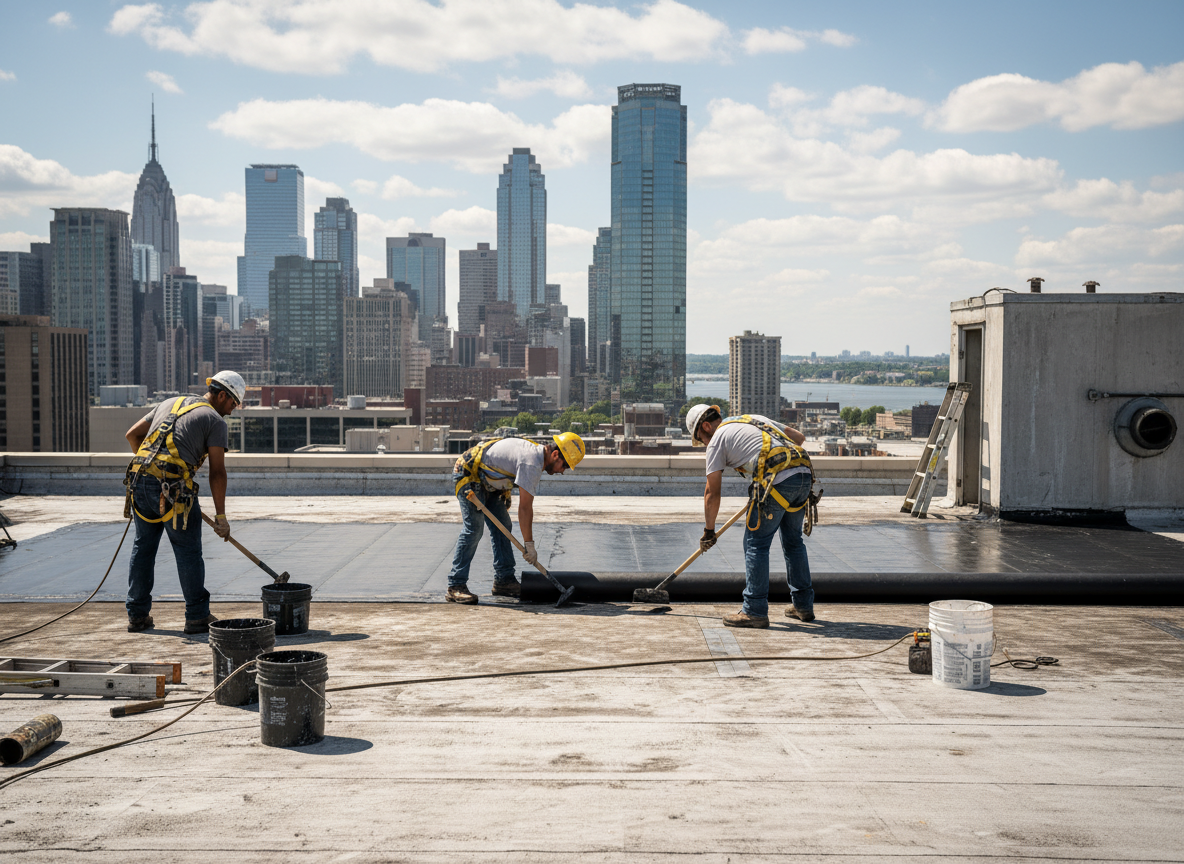
Roof repairs behave differently in winter, and the reason is not that crews dislike the cold. The materials themselves have temperature limits, and ignoring them produces a repair that looks finished in January and fails in April. This is what winter does to a flat roof, and why a competent contractor will often stabilise a leak first and complete the permanent work later.
The mechanism
Freeze and thaw damage is straightforward physics. Water gets into a seam, a blister, a flashing gap or a fastener hole. When it freezes it expands by roughly nine percent, widening the opening. Then it thaws, and the slightly larger opening admits slightly more water. Repeat that through a New Jersey winter and a hairline gap in November is an open pathway by February.
Nothing about this is dramatic on any single cycle. The damage is cumulative, which is why it consistently surprises owners who looked at the roof in autumn and saw nothing worth acting on.
What it actually does to a roof
The damage shows up in a few recognisable patterns.
Seams and laps open, because they were already the weakest line in the assembly and the ice works into whatever gap existed.
Flashing separates at parapets and curbs, often leaving a visible gap. Flashing details move more than the field membrane does, so they accumulate more cycles of stress.
Fasteners on mechanically attached systems back out or corrode, and a raised fastener head becomes a leak point as soon as ice starts prying at it.
Ice dams form at drains, scuppers and low points. This one causes disproportionate damage because a blocked drain in December does not simply pond. It freezes, and the water spreads across the field of the roof instead of leaving it, reaching seams and terminations that would never see standing water otherwise.
Wet insulation freezes and thaws under the membrane. A saturated area of polyiso goes through the same expansion cycle out of sight, breaking down the board and lifting the membrane above it.
Why repairs get staged
Here is the part that is worth understanding before you push a contractor to finish a job in February.
Adhesives and sealants carry minimum application temperatures. Below those, they do not cure properly and the bond will not hold, whatever it looks like on the day.
Hot air welding on TPO and PVC needs different settings on a cold, stiff membrane than on one warmed by summer sun. It can be done well in cold weather by someone who adjusts for it and done badly by someone who does not, and the difference will not show until the first hard temperature swing.
Wet substrate cannot be bonded to. If the area is saturated or frozen, the patch is going onto something that will move underneath it.
So the sequence on a winter leak is usually: stop the water entering the building, dry the area, get a sound temporary seal in place, then return and complete the permanent repair when conditions allow. That is not a contractor avoiding work. It is the difference between one repair and two.
The alternative, forcing a permanent repair in the wrong conditions, produces exactly the outcome owners complain about: a patch that fails within a year in the same place.
The one thing not to defer
Water actively entering the building gets stopped immediately regardless of conditions. Tarping, temporary sealing and clearing blocked drains all happen straight away, because water running into the assembly through the rest of a winter does far more damage than a staged repair does.
The staging applies to the permanent fix, not to stopping the leak.
Checking under the patch
One thing worth insisting on: before anything gets patched over a soft area, someone should establish whether the insulation underneath is wet. A saturated section of polyiso will keep freezing and thawing under a brand new membrane patch, and the repair will fail from below while looking sound from above.
Core samples or an infrared scan answer that. Where the insulation is wet, it has to be cut out and replaced, and that is a bigger job than a patch, which is precisely why it gets skipped by contractors quoting to a number.
Getting ahead of it
Most freeze and thaw damage is preventable, and the intervention is unglamorous. An autumn visit that clears the drains, renews sealant at terminations and pitch pans, and reseals lifted seam edges removes most of what the winter would otherwise work on. Debris left in a drain through October and November is what causes the December ice dam.
A spring visit then deals with whatever the winter did open, while the damage is still confined to one detail rather than spread across a section.
Commercial roof maintenance on that spring and autumn cycle is what prevents this category of damage, and a commercial roof inspection before winter identifies the details that will not survive it. For damage that has already happened, commercial roof repair covers the seam, flashing and fastener work, and commercial roof leak repair covers detection and wet insulation removal where water has already got in.
Related reading: why ponding water is the leading cause of flat roof failure, since standing water in autumn is what freeze and thaw works on all winter.