
2026-08-17 · Mike Dalton
Selecting Materials for Commercial Roof Repairs Near Coastal Areas
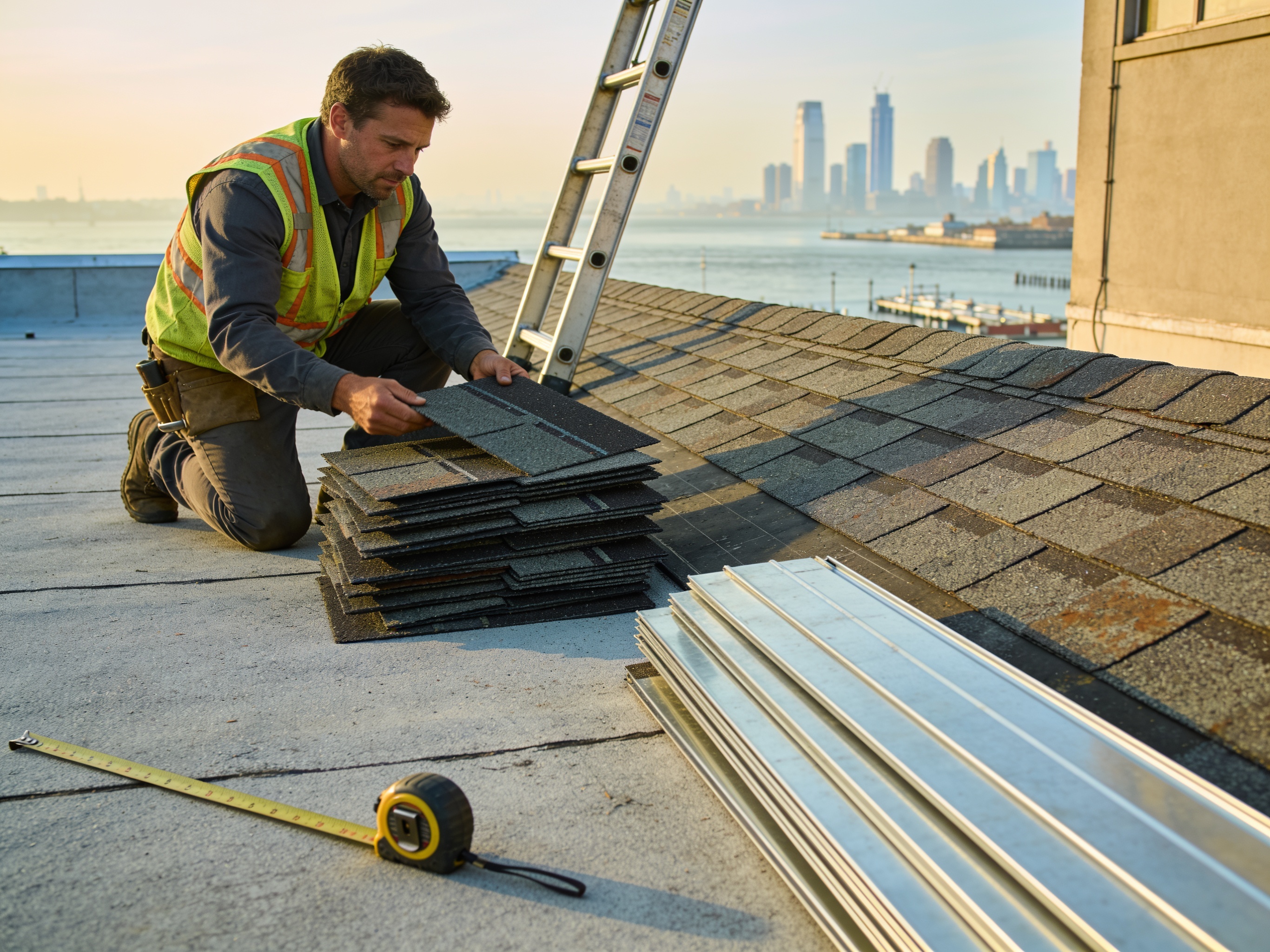
Choosing the right material for a commercial roof repair near Jersey City's waterfront comes down to three real options for most flat and low-slope buildings: TPO (roughly $6–$9 per sq ft installed for full sections, less for patch repairs), EPDM (about $5–$8 per sq ft), and modified bitumen or metal flashing details for edges and parapets. For buildings in Paulus Hook, Liberty Harbor, and Exchange Place — anywhere within a mile or so of the water — salt-laden air and near-constant humidity swings push me toward TPO or EPDM over cheaper coatings every time, because those seams and membranes resist salt-driven corrosion better than exposed metal fasteners or unprotected asphalt.
Why Coastal Proximity Changes the Material Math
Jersey City sits close enough to Upper New York Bay and Liberty State Park that airborne salt is a real factor, even blocks inland in Journal Square or The Heights. Salt accelerates corrosion on exposed metal fasteners, rusts flashing edges, and can degrade lower-grade sealants faster than inland buildings ever see. Combine that with our humid subtropical climate — hot, sticky summers and cold winters — and you get a membrane that's constantly expanding and contracting while also fighting moisture intrusion. I've pulled up 8-year-old repairs on buildings near Paulus Hook where standard galvanized screws were rusted through, while the same repair three miles inland in Greenville still held tight. That's the difference coastal exposure makes.
Material-by-Material Breakdown
Here's how the main options actually perform on the ground for repair and patch work in this area:
- TPO (Thermoplastic Polyolefin): heat-welded seams resist salt intrusion better than adhesive-only laps; lasts 15–20 years; best for flat roofs on retail and office buildings in Newport and Hudson Exchange.
- EPDM (rubber membrane): flexible in temperature swings, handles our winter-to-summer range well, typically 20–25 years lifespan; good for older warehouse-style buildings in Bergen-Lafayette.
- Modified bitumen: solid for patch repairs on older built-up roofs, but seams need extra attention near salt air — I use torch-applied rather than cold-adhesive near the waterfront.
- Metal flashing/coping: stainless or aluminum-coated steel outperforms plain galvanized at drip edges and parapet caps, especially on buildings facing Ellis Island or open water views where wind-driven rain hits hardest.
Each of these ties into whether you're doing a flat commercial roofing system or working with TPO commercial roofing or EPDM commercial roofing specifically — the underlying deck condition often decides which membrane makes sense for a repair patch versus a full section replacement.
Matching Material to the Repair, Not Just the Roof
Not every leak needs a membrane swap. If you're patching a 3-foot blister or resealing a seam near a rooftop unit, matching the existing material (TPO to TPO, EPDM to EPDM) is almost always the right call rather than introducing a new system that won't bond properly. But if the existing membrane is already brittle, chalky, or has multiple failed seams — which I see often on buildings near Van Vorst Park that still have their original 1990s-era roofing — a broader commercial roof repair that replaces a larger section with matched-grade TPO or EPDM is more cost-effective than chasing leaks year after year. When more than 25–30% of the roof needs attention, it's usually time to talk about a full commercial roof replacement instead of continued patchwork.
Practical Considerations for Jersey City Building Owners
A few things I tell every property manager before we start material selection:
- Check your fastener spec. Standard galvanized fasteners near Liberty State Park or Exchange Place corrode faster than stainless or coated alternatives — the upcharge is usually $50–$150 per job and worth it.
- Budget for seam inspection, not just membrane cost. Salt air degrades sealants at seams before it degrades the membrane field itself.
- Think about wind uplift. Buildings near open water in Liberty Harbor or facing the Hudson see stronger gusts; mechanically-attached TPO systems often outperform fully-adhered ones in these spots.
- Get eyes on the roof twice a year. A quick commercial roof inspection before and after summer catches blistering and seam separation before it becomes a full leak.
These small decisions compound over a roof's life, and skipping them is how a $400 patch turns into a $12,000 section replacement three years later.
Bringing It Together
If you're weighing material options for a repair near the Jersey City waterfront — whether your building sits in Bergen-Lafayette, overlooks Newport Centre, or is a few blocks from Journal Square — the salt air and humid subtropical swings we get here mean the cheapest material up front rarely wins long-term. TPO and EPDM both hold up well when installed and repaired correctly, and matching fastener and flashing materials to the coastal environment matters as much as the membrane choice itself. If your roof is already patched repeatedly or showing seam failure in multiple spots, it's also worth reading up on when to choose repair over full replacement for flat roofs before committing to another round of patchwork. We're based at 61 Grand St here in Jersey City and take calls Monday through Friday 8am–6pm and Saturday 9am–2pm if you want an honest look at what your roof actually needs before spending on materials.